 “Grief Gator,” Catherine Raine, 2010
 “Grief Gator,” Catherine Raine, 2010
I sewed Grief Gator in the basement cafeteria at the Art Gallery of Ontario. My friend Ellen was with me, and she made an amazing fish-like creature.
“Grief Gator,” Catherine Raine, 2010
“Grief Gator,” Catherine Raine, 2010
I sewed Grief Gator in the basement cafeteria at the Art Gallery of Ontario. My friend Ellen was with me, and she made an amazing fish-like creature.
 “Cosmic Sunrise Tadpole,” by Catherine Raine, 2010
I had a lot of fun pouring the wax and paint mixture and then dabbing on lots of blobs.
Here’s a true story that gave me goosebumps. It features a community-made quilt in a library, a random question, family bereavement, and serendipity.
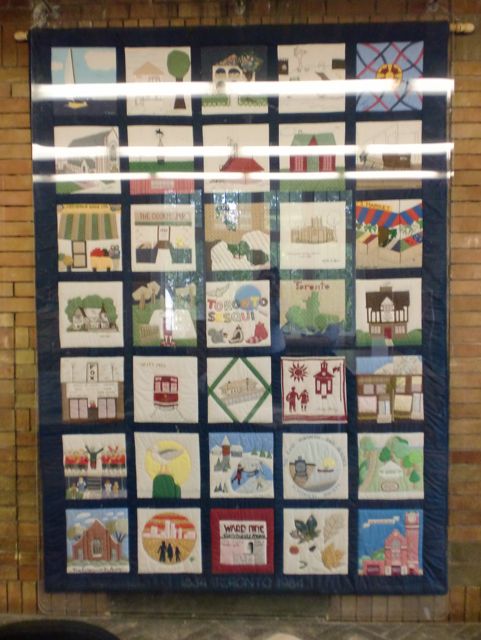
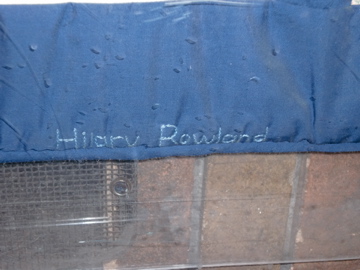
About six weeks ago, I visited Main Street Library and was entranced by a large quilted tapestry hanging on the east wall of the attic. Created in 1984 to celebrate 150 years since the founding of Toronto, the Sesquicentennial Quilt warmed the space with its well-crafted charm. At the bottom of the piece, I noticed the name Hilary Rowland written in thread. I assumed that she had designed the art project, which featured 35 individual blocks in rows of five.
Curiosity about the quilt led to a Google search for Hilary Rowland. No on-line information was forthcoming, so I called Main Street branch to see if the staff had any recollection of her. The person who answered the call couldn’t help me, but she promised to leave a message for Susan Truong, the branch head.
Later that day, Ms. Truong called me at home with the news that none of her colleagues could remember anything about Ms. Rowland. After all, it had been twenty-six years since the quilt was completed.
A few more weeks passed, and then I received another communication from Ms. Truong. Her e-mail stated that she had received a call from Hilary Rowland’s daughter, Susan Plummer, entirely by coincidence. Susan had called Main Street branch to see if the librarians were interested in Sesquicentennial Quilt postcards and posters that she had unearthed while sorting through her late mother’s effects. When Ms. Truong mentioned my query about the quilt’s creator, Susan was touched that someone had shown interest in her mother’s work. She gave the branch head her phone number and said she would be glad to talk to me about the quilt.
When I spoke to Ms. Plummer a few days later, she confided that she had only recently been able to face opening the box containing the Sesquicentennial Quilt’s promotional materials (or any other boxes). Tragically, Susan lost her mother in May and her father in July of this year.
Sharing personal stories with stranger at a time of grief takes courage and emotional generosity. When the memories came tumbling out, it felt like being present with Susan as she opened the box.
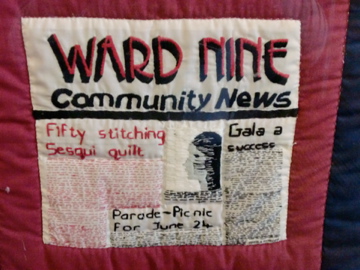
Back in 1984, Hilary Rowland was the coordinator for the Beaches Sesquicentennial Committee for Ward 9. As part of her duties, she recruited approximately 90 volunteers to sew a commemorative tapestry that depicted Beaches images. Each panel was a visual answer to the question, “What do you think of when you think of The Beaches?”
Hilary selected 25 different background fabrics for the quilt, but she left each block’s artistic interpretation up to the person working on it. Hilary must have been a persuasive woman because she managed to convince Beaches residents with variable sewing skills to contribute to the project. Abilities ranged from complete non-sewers to fancy quilters who could pull off reverse appliqués (as seen on the Fire Station #17 block below).

Susan’s mom even got her whole family to join in the quilt’s co-creation. Her husband made the train station panel, and the green diamond represented his perspective as a child looking through the fence at the station. (He had grown up in the Beaches, and so had his future wife, minus the first six years of her life spent in England).
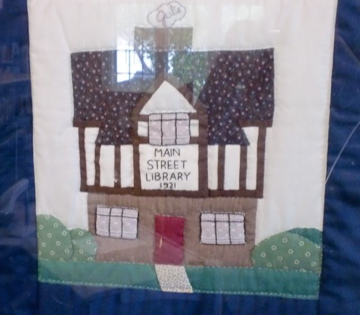
One of Susan’s sisters sewed the lifeguard panel, and the other one made a cloth rendition of Main Street Library.
Susan herself, who was 19 at the time, created the seagull square. Her grandparents were responsible for the Woodbine Racetrack block. And Hilary did the Fox Theatre segment in addition to the design and coordination work for the entire project.


Once all 35 blocks were finished, Susan’s mom experimented with different arrangements before deciding on the final composition. Like a collage artist, she spread all the squares on the floor and studied the colours and themes. She ended up choosing a navy blue border to pull the entire piece together.
Then the quilt was put on a frame in the living room of a woman named Carol Wilkie. The rest of the work was completed by hand on the frame. Carol would leave her door unlocked, and volunteers arrived in shifts. “They’d come in, have tea and cookies, and quilt for an hour,” recalled Susan. (I love the concept of “Come on in and quilt!”).
Susan’s pride in her mother, who had “taken a quilting class and got excited,” was apparent in her voice. She also fondly remembered the community spirit that animated the Sesquicentennial project. Out of the 90 volunteers, she personally knew the ones who had worked on 20 of the 35 blocks.
I’m grateful to Susan Plummer for narrating the origin story of a one-of-a-kind quilt that both enriches Main Street Library and serves as a priceless legacy to Hilary Rowland’s memory, her family, and the Beaches community.
On a personal note, connecting with Torontonians like Susan Plummer and April Quan (the creator of the Deer Park Woolen Castle) has been an unexpected benefit of writing a library blog. If I hadn’t blogged about the Woolen Castle or Main Street’s Sesquicentennial Quilt, I would never have learned that April fashioned the castle from a secondhand wool coat or that Susan discovered historical treasure in a box that was painful to open.

This morning I went to Mount Pleasant Library to hear Hedy Bohm tell her story of survival. A quietly charismatic woman with a vivid orange scarf, Hedy didn’t waste a moment of the pre-talk waiting time. She greeted two classes of grade 7 and 8 students and passed around large photos of Auschwitz-Birkenau as it looks today. She also showed us a memory book which dates from her school days in Oradea, Romania before the war. Later she told us that her aunt, who was married to a Christian man and escaped deportation, had managed to save the book for her.
Hedy’s storytelling style was deeply engaging, and she had a gift for recollecting details that helped the audience visualize scenes from her past. The smell of fresh wood shavings in her father’s furniture shop. The grade 10 assembly where she and her classmates learned that schools for Jewish children had been closed. The single window with barbed wire on the cattle car. Fanning her mother with a hankie because the car was so stifling. The single pail that served as a toilet for 80-90 people trapped for three days in a dark box on wheels.
Most excruciating of all were Hedy’s final moments with her parents. When the train stopped at Auschwitz, the German soldiers immediately began separating the people into groups. Hedy’s father was sent to the left and she didn’t even have time to say good-bye. Her mother was ordered to the right. When Hedy tried to run after her, a soldier blocked her way with a loud “No!” She started to cry and then yelled her mother’s name. “She turned and looked at me. I’ll never forget it. She didn’t seem to know where she was. Her face is seared into my memory. Within a few minutes, I became an orphan.”
At Auschwitz-Birkenau, Hedy endured chronic starvation and the terrifying uncertainty of daily “selections” from line-ups. Eventually she was sent to a former Volkswagen factory in Germany that had been turned into an ammunition plant. As an enslaved labourer, she worked on V-2 rockets and landmines for twelve hours a day and often had to hide in an air-raid shelter. To raise morale during bombings, Hedy and her companions would recite poems, sing together, and exchange recipes. “One woman told us the secret of her stuffed cabbage recipe. She used a little bit of caramelized sugar that she burnt on the stove.”
The final segment of Hedy’s wartime nightmare occurred when her group of munitions labourers was sent back to a concentration camp, where they went a week without food. Much to the inmates’ disbelief, this camp was liberated by the American army, and they were allowed to go into the local village and take what they needed from the textile shops and grocery stores, even the candy shops. Hedy smiled when she recalled the material she picked out for a peasant skirt, “which was very fashionable at the time.”
Ms. Bohm’s passionate mission to share her story shone through every single word she uttered. When she said that she had kept silent about unspeakable experiences for 50 years, I was struck by the courage it took to wrench words from a place of anguish to help others comprehend what she suffered. What caused her to break silence was outrage at Holocaust denials and the imperative to speak now for the sake of future generations.
Near the end of her testimony, the entire room was electrified when Hedy looked all of us in the eye and said, “I want you to remember what happens when good people do nothing. From now on, you be my witnesses.” Encouraging each of us to stand up and speak out against discrimination, she had us on our feet when the talk finished. The schoolgirls sitting to my right had tears in their eyes, and they waited patiently in line to speak to Hedy. She was busy receiving warm hugs from some of the other kids, shaking hands, and inhabiting the centre of a huddle of students who wanted to talk to her. My throat constricted as I witnessed so many young people responding to the presence of a truly beautiful and resolute spirit.
During the 30th Annual Holocaust Education Week, I attended an unforgettable afternoon talk. In Deer Park Library’s program room, 85 year-old Helen Schwartz testified to the loss of her entire family and “everything that was dear to me.” In the face of monstrous cruelty, she survived the Bialystok Ghetto in Poland, numerous concentration camps, starvation, beatings, and two trips to the crematorium. She said it was her natural chubbiness which saved her both times; the Germans said she still had enough “meat on her bones” to work.
Many of us in the audience cried as we listened to this petite great-grandmother remember the Germans “packing (Jews) like herrings in a synagogue and torching it,” having to hide her younger brothers in boxes, and carrying out the bodies of the dead at Bergen-Belsen. She can never stop hearing the typhus-stricken girls calling for water.
In attendance at the talk were about twenty adults and a group of middle-school children sitting on the floor. Towards the end of her testimonial, Ms. Schwartz addressed the children specifically, although we all need to cherish these words: “Be good to each other. Respect your mother and father. Be good to your brothers and sisters. I would have given anything to see my family after the war.” She almost broke down and then apologized, saying it happens more as she gets older.
I loved what she said at the end of the talk. “Anybody wants to ask me something? I’m still here.”