















Exhibit Background for Catherine Raine’s “Maps of Loss: Rivers, Ruins, and Grief” (Richview Library, September 2011)

September 16th, 2011

I rediscovered my love of art when I was 38 years old. The spark was a wonderful course facilitated by Erica Ross called “Create Your Own Healing Deck” at Sheena’s Place in 2007. By the end of the class, I had created more than a dozen cards that contained encouraging words and images to help me address my struggles with emotional eating.

My collages were exhibited at Sheena’s Annual Art Show (2007 and 2008), and I continued to attend classes there, including Erica’s “Dance Our Way Home” and Ellen Jaffe’s “Writing Your Way.” The prose-poem which accompanies “Ruined Barn” in this exhibit emerged from a writing exercise in which Ellen asked us to imagine ourselves as a landscape. “Barn Memory” wrote itself in a white-water rush, a lament for past and current losses:

I am a ruined barn, empty but smelling of ancient hay. I sit in a lost valley, no longer a shelter nor part of a living farm. I used to be warmer, to glow orange from lanterns on February mornings, to retain animal heat. Now my shadows fill in their outlines, random headlight baths from the highway my only relief.

 All my sounds are whispers and echoes now, where once I heard grunts, shouts, whinnies, cries of pain and hunger. It’s so quiet now. Ruin is quiet . . . . I miss being whole. I miss being real. I miss the animals I used to protect. (For complete text, see “Ruined Barn” collage in the exhibit).

“Ruined Barn” by Catherine Raine, 2010 ($250) All photos of exhibit artwork by Stewart Russell

 I believe “Barn Memory” and the collage I later composed to illustrate it were the “grief-seeds” (Rumi) at the root of Maps of Loss: Rivers, Ruins, and Grief.  Even though I made the encaustic painting “Inner Map: Non-Political” three years after I wrote the barn piece, there is a living connection between these two inner landscapes and the eight other works of art you see at Richview Library today.

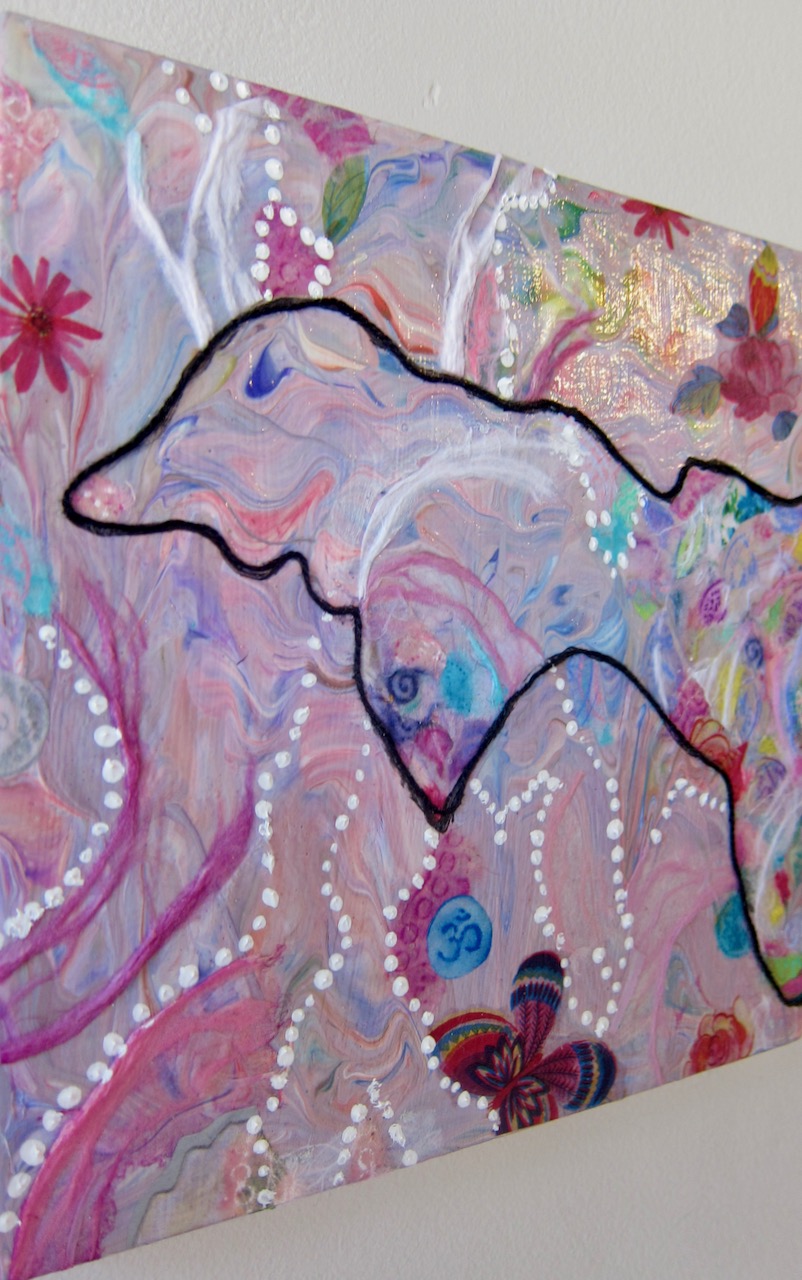
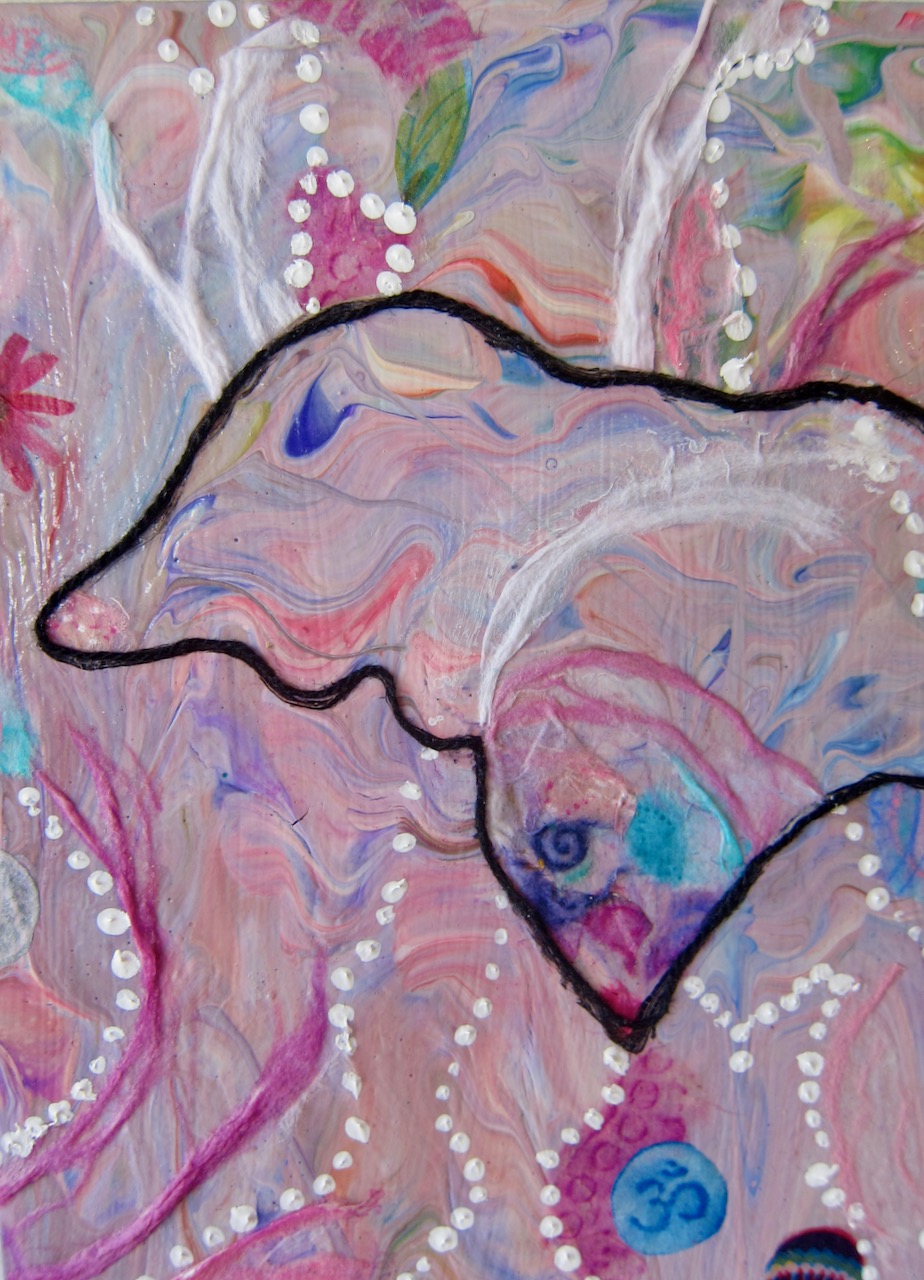
“Inner Map (Non-Political) by Catherine Raine, 2010 ($200)

Maps of Loss has helped me articulate feelings of grief and map them visually, divining underground rivers of emotion that I hadn’t felt or even detected beneath the surface. This personal excavation has revealed unexpected artifacts, including a “Trippy Pier to Nowhere,” a heron (“Heron and Ladder”), a “Woman in Purple Bed,” and rivers (“Tidal River” and “Encaustic River Beast”). For me, these pieces speak to mystery, solitude, and a sense of moorings washed away.

“Trippy Pier to Nowhere” by Catherine Raine, 2009  SOLD!
“Heron and Ladder” by Catherine Raine, 2009  SOLD!
“Woman in Purple Bed” by Catherine Raine, 2009 ($150)

In July 2010, my childhood friend Jenny died of cancer at age 41. On the day she died, I went to the Picture Collection at the Toronto Reference Library to look for meadows and purple irises, Jenny’s favourite flowers. I felt connected to Jenny when I pored over a folder containing peaceful scenes from nature. And when I memorialized my friend in “Jenny’s Purple Iris,” I used the irises to create an organic gown, a vision of peace in her body after the suffering ended.

“Jenny’s Purple Iris” by Catherine Raine, 2010 (Not for sale)

In the fall of 2010, I distracted myself with a continuing education course in encaustic painting at the Ontario College of Art and Design. I learned how to melt wax to create tactile pieces that smelled of beeswax, and the three encaustic paintings in Maps of Loss come from my time at OCAD. Two of these pieces contain rivers, which reflects one of my earliest influences. Having grown up near the banks of the Missouri River, rivers mean home, time passing, movement, and change. They also represent uncensored feelings: unpredictable, fierce, embodying invisible currents and the wild mystery of eddies.

“Tidal River” by Catherine Raine, 2010 ($150)
“Encaustic River Beast” by Catherine Raine, 2010 ($150)

The remaining two pieces, “Lenin’s Mosaic” and “When Ruins Swoon,” flow back to the beginning, connecting me to “Ruined Barn.” The central photographs in both collages depict ruined houses in the former Soviet Union that have partially returned to nature after nuclear disaster. These images of Cold War wreckage haunt me because my father’s health was also ruined by this war. When he was in the United States Navy in the late 1950’s, he witnessed atomic blasts in the Pacific Ocean as part of a testing program during the nuclear arms race. From his post on Midway Island, he and his naval comrades watched the blasts without any protective gear, and the cancers he later developed correspond to cancers caused by radiation exposure. He died in 1995 at the age of 58.  (Jenny promised to give him a hug for me).

“Lenin’s Ruins” by Catherine Raine, 2011 ($250)  Central image photo by Gerd Ludwig
“When Ruins Swoon” by Catherine Raine, 2011 (Not for sale)

A ruined barn, house, or room can symbolize a body stricken by illness, once vital but now a broken husk. Ruins also represent loss, mortality, and history; they are relics of forgotten worlds. Like rivers, they testify to the inescapable passage of time. Like maps, they locate a particular grief or loss in a specific time and place. They are both tangible and abstract, accessible and remote.

To add an element of hope to the ruins, I have enveloped them in mosaics that suggest new colour and growth. Thank you for taking part in my own artistic growth by viewing Maps of Loss. Your presence helps me answer Rumi’s question: “Where will you plant your grief-seeds?”(Illuminated Rumi, translation by Coleman Barks)

“Maps of Loss: Rivers, Ruins, and Grief” Exhibit at Richview Library (September 2011)

Inspiring Stories from Survivors

September 5th, 2011
The following short article was recently published in the Summer 2011 edition of First Light (a biannual publicationo of the Canadian Centre for Victims of Torture). I’d like to post the article on my blog for readers who may not otherwise have heard of First Light.

Transformative Student Testimonies from Two CCVT Journal Entries

By Catherine Raine  (LINC Instructor 2004-2010)

            When Ezat Mossallanajed invited me to contribute some writing on the topic of “love, compassion, and forgiveness in the rehabilitation of survivors,” I went to my journals to look for stories. I found a couple of entries which speak to survivors’ extraordinary inner strength, gratitude for life, and desire to help themselves and their communities.

January 20, 2010

I’ve been enjoying the student presentations in my CCVT English class because they’ve created a listening space that feels fresh and new.  So far, students have talked about computers, Albania, Eritrea, and fun places to visit in Toronto.

We also listened to a more personal narrative about a student’s struggle as a refugee claimant. She told us that she fled from her home country not once, but twice. The first time was because of war, and then her family returned when political independence was achieved. Sadly, conflict flared up again, so she left for good. Now she lives alone in Canada while her children and grandchildren reside in Europe and the Middle East.

I asked the speaker how she stayed so positive. “You smile all the time. How do you do it?”

“I have a lot of friends, and I like to help them. I am part of a community. When I break the fast at Ramadan with everybody, I don’t feel alone.”

She then asked me why some people in North America stay so negative: “Why they don’t give thanks for all the good things they have?”

 February 22, 2010

This morning one of my students gave a very moving presentation about the struggle to come to terms with her new life in Canada. When she came here less than two years ago, she had no English, no money, and no friends or family. In the shelter, she slept all the time because she was so homesick.

“Then I decided to have a talk with myself. I told myself it wasn’t good for me to sleep so much. I needed to study English.”

She was scared because she hadn’t gone beyond middle school in her home country. Regardless, she steeled herself for the task because she knew she had to have English communication skills to survive in Canada.

“On the first day of my class at CCVT, I cried because I couldn’t understand my teacher, Susanna. She was kind and told me not to cry. She said that she would help me.”

With Susanna’s compassionate encouragement, my student didn’t give up, and in two years, she has progressed from not knowing a single word of English to speaking in front of the class for fifteen minutes. She found the strength to fight for her new life when she could have just kept sleeping all day to escape reality. She’s a heroine to me.

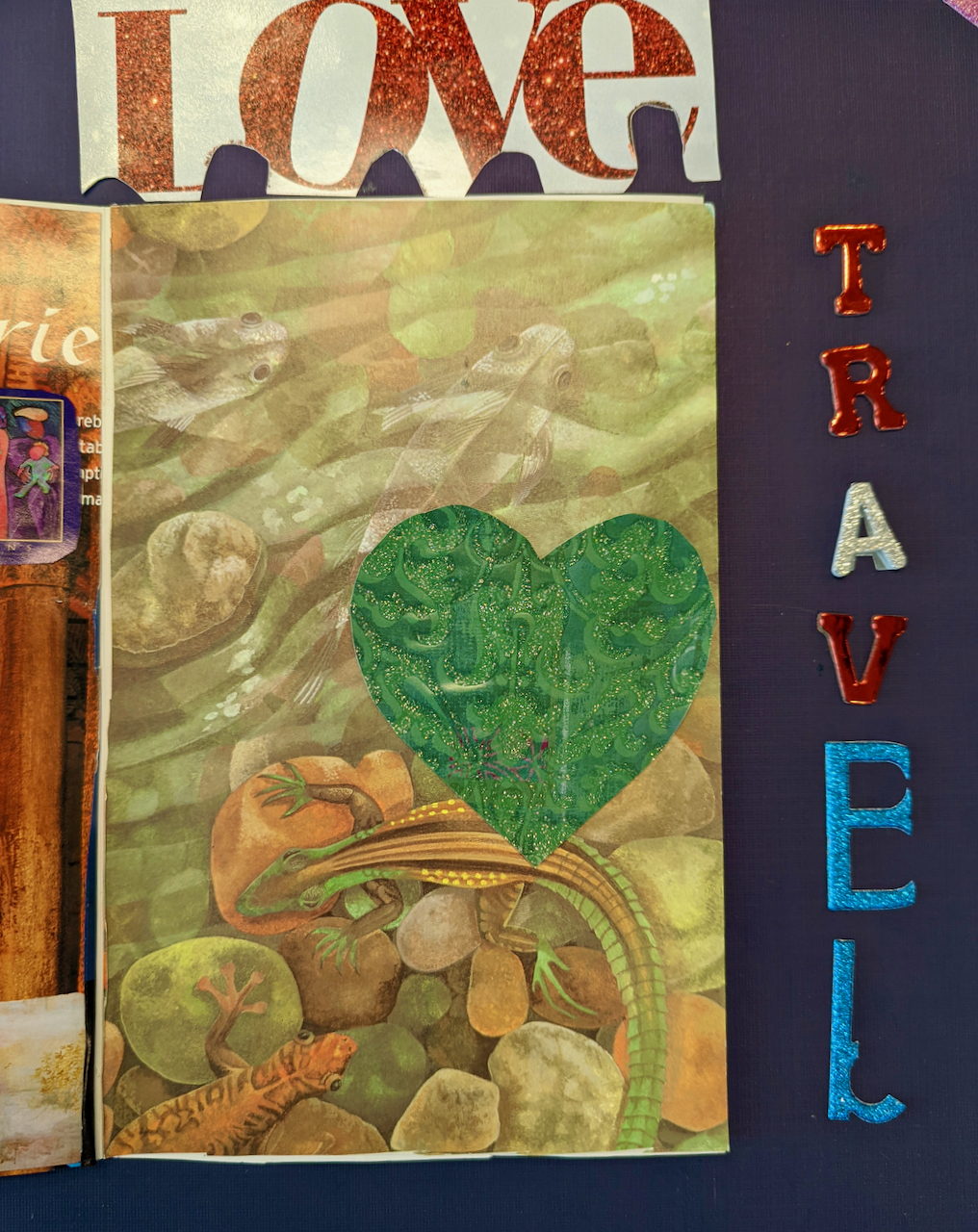
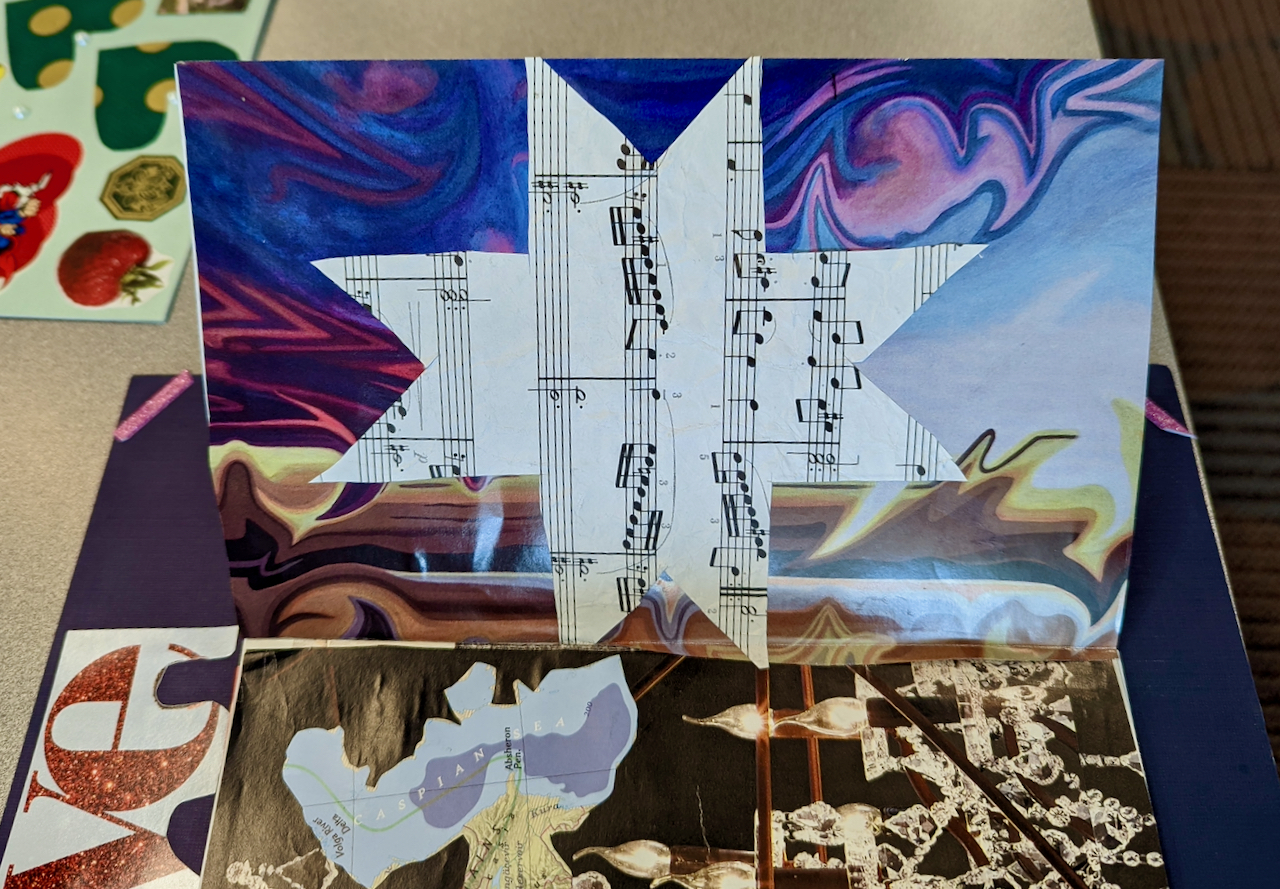
Wild Beaded Rivers Collage by Catherine

August 23rd, 2011
Wild Beaded Rivers by Catherine Raine, 2011

I’ve always liked beaded necklaces, and I think they do a great job representing rivers. I finished the collage this morning in a celebratory “I’m officially on vacation!” mood.

Wild Beaded Rivers by Catherine Raine, 2011

Experience Art at Richview and Northern District Libraries

August 21st, 2011

I’m excited to report that my art exhibit, Maps of Loss: Rivers, Ruins, and Grief, will be on display at Richview Library from September 7th to the 30th. This exhibit excavates personal feelings of grief and translates them into more universal symbols of loss. When viewers encounter three encaustic paintings and seven collages, they will experience images such as a tidal river, a ruined barn, and a pier with no dock.

Lenin’s Mosaic by Catherine Raine, 2011 (Central image by Gerd Ludwig)

Please come to the opening for Maps of Loss at Richview’s gallery on Saturday, September 10th (3-4 pm). Refreshments served!

The exhibit finishes at the end of September, but the beginning of October heralds another art event. On Saturday October 1st, Ellen Jaffe and I will be offering a Collage and Poetry Experience workshop at Northern District Library as part of the Culture Days program. This free workshop will take place from 10 am to 1 pm. For more detailed information, please click here.

Flower-Hatted Otters by Catherine Raine, 2011

The Richview exhibit and workshop at Northern District unite two of my passions: libraries and art. I have blogged about both TPL branches as part of my quest to visit all 99 libraries in the system, and I have also found wonderful inspiration and materials from the Picture Collection and second-hand bookstore at Toronto Reference Library (as well as the sister bookstore at North York Central).

Libraries are natural homes for artists, and I feel so fortunate to share my work and experience at two wonderful branches!


Purple Gratitude Sheet at Dancemakers

August 9th, 2011

It was my turn to DJ my women’s dance meeting last month. When I arrived at the Dancemakers studio, I put a king-size purple sheet on the floor near the windows. The sheet became our canvas for the session’s theme: Dancing in Quiet Gratitude.

In my music set, I included a number of songs that held the light: “Thread the light” (Glen Hansard‘s “This Low”), “There will be a light” (Ben Harper and the Blind Boys of Alabama), “There’s still a light that shines on me” (“Let it Be“), and Brian McMillan‘s encouraging lyrics in “Let the Darkness Go.”

Photo by Stewart Russell  (Yes, those are Stewart’s toes in the lower right corner!)

I invited my fellow dancers to decorate the purple sheet in response to the theme of gratitude. I had some fabric markers, but the small bottles of neon fabric paint proved more popular. The four of us filled the sheet with these words and images: rivers, voice, movement, bosoms, silliness, mistakes, great-grandmothers, grandmothers, mothers, daughters, safe girls, spirit, breath, the forest, laughter, rocks, fierce winds, night, moon, kindness, creativity sheets, raindrops, flowers, hope, fire, goldfinches, fierce goddess, play, community, beauty, thunder, food, wild grasses, health, smiles, art, ocean, a tomato, You!, a foot, refreshing tears, music, and lightning.

All remaining photos by Catherine Raine

Over the course of the two-hour music set, the purple sheet’s function evolved in a wonderful way. At the beginning, it was a picnic blanket on which to gather and discuss the theme of the session. When the music began, the sheet was a connecting fabric; all of us were lying on the floor with some part of us touching the sheet, whether it was only a head or an entire body curled up on it.

As the dance progressed, we crouched at the edges of the purple canvas each time we felt inspired to write or draw. Then we moved in to fill the centre when we were deeper into the set. And towards the end of our time in the studio, I started squirting fabric paint at random, and soon we were all squeezing the bottles and giggling as blobs of paint rained down on the sheet without constraint.

While we were collaborating on our modern art experiment, Brett Dennen was singing “Blessed is this life, and I’m going to celebrate being alive.” I felt that we honored the spirit of his words beautifully.

When the music ended, we were back in a circle, gathered around the no-longer blank sheet. Each of us talked about what images caught our fancy (the tomato, for me!). Then we ceremoniously folded up the sheet, even though I realized to my dismay that the fabric paint was still wet.

When I got home, I had to sort of peel the sheet apart! There were plenty of smears and blobs, but luckily most of the words and pictures remained clear. I hope you enjoy looking at the Purple Gratitude Sheet as much as we enjoyed making it!

Soul of a City Under Threat

July 26th, 2011

Yesterday I signed an on-line protest against a municipal proposal that might close some library branches and introduce elements of privatization. I am passionately opposed to these cost-cutting measures, for they would impoverish our city’s ability to uplift and educate all Torontonians regardless of age, language, or income. Our ninety-nine branches are a richly diverse expression of a city’s soul, providing a nexus of human connection in an increasingly fragmented and disconnected world.

City Hall Library’s Children’s Nook

A newcomer to Canada since 2002, I have spent the last four years blogging about all 99 branches in the Toronto Public Library system. As an experienced library pilgrim, the notion of a Toronto Private Library makes me shudder because privatization would desecrate the democratic ideals upon which the free library was established in 1883: “the free public library’s purpose was to help in the cause of education among all classes of the population” (Margaret Penman’s A Century of Service: Toronto Public Library 1883-1983, page 6).

Stairs to Upper Level, Agincourt Library

I do not want 128 years of progressive history to be demolished on a political whim. After all, libraries do not ride gravy trains. They don’t travel to expensive conferences in Hawaii or linger over lunches at the top of the CN Tower. And the tabloids seldom show pictures of library branches embroiled in sex scandals.

On the contrary, libraries are places to study for the TOEFL test, join a knitting circle, daydream from a window seat, create a crazy quilt, fill a shopping bag full of picture books for your children, and relax with a newspaper in your first language.

Historic Main Street Library‘s Attic
Barbara Frum Library
Crazy Quilt at Jones Library

If we commercialize one of the last truly public institutions in the city, what will be next? We cannot afford to lose ground, for we’ve lost so much already to a culture of greed, intrusive advertising, and the dominance of the profit motive. Libraries are too special, too important to betray their founding principles without a fight. It’s time to speak out against proposals that strike at the heart of a great city’s soul. Sign the petition, call the mayor, and help us protect our libraries.

Port Union Library
April Quan’s Woolen Castle at Deer Park Library
Mural at Morningside Library

Sand Doors Meditation by Catherine

July 23rd, 2011
Sand Doors Meditation, Collage by Catherine Raine, 2011

When I saw Marsel van Oosten’s photograph (2011) of a ruined Namibian house half full of sand, I immediately tore it out of National Geographic. The scraps of paper which compose the border mosaic come from brochures, magazines, and a calendar.

Importantly Groovy City Hall (1965)

July 16th, 2011

On my first visit to City Hall Library in 2007, I described it as “cozy yet important.” The small size of the branch (5,074 square feet) made it cozy, and what made it feel important was the lofty ceiling and serious grey walls (appropriate for its dignified status as co-tenant with Toronto’s municipal government offices).

After my second visit, I’d like to add the adjective “groovy” to complement cozy and important. In fact, grooviness saved City Hall from taking itself too seriously, as evidenced by this triangles-on-acid painting and the lively view of Nathan Phillips Square available from the south-facing windows.

I wasn’t the only one who enjoyed sitting in front of the south windows, for I noticed piles of magazines left behind by afternoon readers. (A staff member told me that they have lines out the door during lunch hour). Stacked at random on a long stone bench were slightly rumpled editions of People, Hello (“The Dazzling Duchess!”), Popular Science, Spiderman, and Vogue.

One weighty tome stood tall among the fluffier reading fare on the bench: Canada: An Illustrated History. And I personally added several more books to the piles of reading material: the colourful Let It Shine, a book about Albanians who sheltered Jews during World War Two (which one of my Albanian students had told me about), and a sample from the Chinese collection.

In spite of City Hall’s businesslike vibe, it contained a lot of interesting corners and angles that offered respite from the brisk pace of city life. For example, the small Children’s section was tucked away in the tail of a curved wall. Disc-shaped cushions silently invited readers to settle more comfortably into a beam of sunlight.

Most quirky and mysterious of all was a partially hidden staircase which led nowhere in classic Escher fashion. As I was taking pictures, I noticed a man in a suit walk down the top steps and then disappear behind the walls that hid the bottom half of the stairs. He quickly reappeared at the top, looking confused.

When I asked the temporary branch head, Karen Singer, about the steps, she explained that the library used to occupy more space (11,000 square feet) in the larger City Hall building. In 1996, a substantial part the library’s collection was transferred to Urban Affairs. That’s when the stairs were walled off from the current library space.

The confused staircase man could have benefited from Karen’s explanation, and I hope he eventually found his way out. Better still, I wish he had discovered the entrance to City Hall branch instead. Then he could have picked up a copy of Newsweek or even studied House of Stairs by the south windows in good scholarly company.

Library-sponsored Cultural Outing: Map Pass Rules!

June 26th, 2011

Thanks to a Toronto Public Library Map Pass, I received free admission to the Textile Museum of Canada yesterday afternoon. I saved fifteen dollars and gained a rewarding experience which nourished my imagination into the bargain!

Artistic Garage Door to Museum

In addition to the permanent collection, I enjoyed the gorgeous clothing and wall hangings on display as part of “Silk Oasis on the Silk Road: Bukhara” and the diverse elements of “Magic Squares: The Patterned Imagination of Muslim Africa in Contemporary Culture.”

Wrapper from Nigeria, 1970′s
Egyptian Door Hanging (1920-1929)

My favourite part of the library-sponsored trip was listening to the 99 attributes of God in Arabic as I sat on the floor in front of Alia Toor’s 99 dust masks embroidered with these Names. I don’t know how to read Arabic script, but I recognized a few of the words being recited into my ears via a pair of Sony headphones: Ar-Rahim (the Compassionate) and Al-Hakim (the Wise).

“99 Names of Aman” (2004) by Alia Toor

After I left the soul-enriching exhibit and was about to exit the building, a family of three entered the lobby. And what did they give the cashier at admissions? A library Map Pass, of course!

Fiddlesticks

June 16th, 2011

I was so looking forward to hearing Métis fiddler Anne Lederman perform at Centennial Library this evening, a program which the TPL website listed as starting at 6:15 with a 7 pm finish. I was crestfallen when I arrived at 6:30, only to be told that the event had ended at 6pm.

In a why-did-I-drive-for-45-minutes funk, I picked out a couple of soothing CD’s and returned to the parking lot. Thus endeth my first ever disappointment with a TPL library program. I think I’ll choose one a little closer to home next time!

Distinguished Barbara Frum (1992) Doesn’t Disappoint

June 11th, 2011

I first wrote about Barbara Frum Library in a 2007 post called “Libraries, the Sequel,” which contained notes about seventeen branches. The blog has evolved a lot since then, and it’s Barbara Frum’s turn to receive more in-depth attention, complete with photos.

A large district branch near Lawrence and Bathurst, Barbara Frum was named in honour of the famed CBC broadcaster and journalist who died of leukemia shortly before the library opened in 1992.

Barbara’s library impressed me with its comfortable elegance, a composite of palm fronds, floral vine diamonds for carpet, high windows, and soaring ceilings. There were a few signs of wear and tear, including grafitti in the study rooms and a floor lounger with stuffing escaping from the back of the head, but it’s to be expected after nearly 20 years of existence at such a busy locale.

I loved the grand staircase to the second floor (and of course the one that led to the third floor). The landing provided a breathtaking perspective of the temple-like columns beside the main entrance.

The columned east lounge of the main level wowed me, and the Children’s Area in the west wing didn’t disappoint either. I was especially charmed by the friendly jester who stood at the centre of a semi-circular window bench on the north wall. An impromptu puppet show had recently taken place there, for a lone cow puppet lay discarded on the windowsill.

Further whimsicality was provided courtesy of some hand-painted chairs and a matching windowseat on the opposite end of the room from the jester in the window.

The multilingual collection was almost as immense as the sweepingly high walls, and it included the following languages: French, Hebrew, Hungarian, Russian, Tagalog, Chinese, Somali, and Yiddish.

Barbara Frum branch is also home to the Jewish Mosaic Collection, which contains a variety of materials on topics “such as anti-Semitism, the Holocaust, Jewish biographies, music, Kosher cooking and literature” (TPL website on the JMC).

With so much knowledge and beauty to offer, it’s fitting that such a classy community facility carries Barbara Frum’s name forward in memory: a distinguished branch for a distinguished lady.

Churchill Library on a Day of Lakes, Gourd-Banjos, and Romance Novel Heroes

June 4th, 2011

Not far from the shores of Lake Simcoe, there’s a place where you can visit a small community library or make a banjo from a gourd.

Let me explain.

Last Tuesday I accompanied Stewart to Churchill (near Innisfil), where he was attending a banjo-making workshop run by Jeff Menzies. While Stewart was busy in Jeff’s studio, I spent the morning beside the lake and the afternoon at the Churchill branch of Innisfil Public Library.

One of four branches of the Innisfil Public Library system, Churchill’s small size, leafy setting, and friendly staff reminded me of the library in the small town where I grew up in the Midwest. And just as my mother used to take my brother and I on weekly library visits, several Churchill moms brought their kids to the local branch on Tuesday afternoon. One mother-daughter pair arrived with bicycle helmets and awesome summer reading habits, for the mom was able to talk her child into hurrying with the words: “Come on! We’ll be back tomorrow!”

I could definitely see why Churchill patrons would want to be regulars at such a welcoming branch. The librarian had reading suggestions for the parents and stickers for the kids, all of whom she knew by name (like I observed at Perth/Dupont branch in Toronto). In addition to a row of three computers with internet access, there was a nook reserved for children who wanted to play computer games.

With limited space upstairs, the basement was devoted to children’s programs. The librarian told me it was a “work in progress,” but I liked the lower level’s simplicity. It resembled the Baptist church basements of my childhood where I ate potluck suppers on metal chairs and sang about Zacchaeus in a sycamore tree and Jesus having the whole world in His hands.

I returned to the main floor to see if there was a French or multilingual collection. Although I didn’t find any foreign language offerings, I did notice a feature that the Toronto Public Library system lacks: a Reacher.

In the Romance section, I also noticed someone who didn’t seem to need a Reacher to gain access to an alluring shoulder: Lord Lightning. (Thank goodness he wasn’t called Lord Smog Advisory or Lord Drizzle).

I’d like to extend my thanks to Lord Lightning and the hospitable staff at Churchill branch for making my afternoon in their lakeside community such an enjoyable one!

Three More Collaged Bookmarks to Greet June by Catherine

June 1st, 2011

Apparently, I haven’t quite exhausted my bookmark energy. Three more of them were waiting to manifest themselves!

Rumi Shines in Collage and at Don Mills Library (and Indeed Everywhere!)

May 28th, 2011

I first learned about Rumi‘s 13th century sufi poetry in 2002, not long after I had immigrated to Canada. I was listening to a CBC Radio program and became transfixed by a beautiful voice reading Rumi’s verses. Soon afterwards, I bought the book pictured above and began filling it with bookmarks to facilitate access to my favourite lines, which later inspired various collages I made between 2007 and 2008:

Be melting snow

Wash yourself of yourself

A white flower grows in the quietness

Let your tongue be that flower.

Be a full bucket

Pulled up the dark way of a well

Then lifted out into light.

Why stay in prison

When the door is so wide open?

Keep knocking,

and the joy inside

will eventually open a window and . . .

see who’s there.

When I saw the recent announcement that Don Mills branch was hosting a program about Rumi, it was another knock on the door, to which I answered, “Yes! I would love to go!”

On Wednesday evening, I drove through the rain to the library. At five minutes before seven, the downstairs auditorium contained about twenty people, a number which rose to nearly fifty by the time the program ended at 8:15.

Our speaker was Tina Petrova, a remarkable woman who survived a 6,000 foot plunge in a jeep thirteen years ago. The spiritual crisis that she suffered as a result of feeling imprisoned in a broken body led her to consider suicide. On the darkest night of her soul, she had a dream in which Rumi’s poetry spoke to her. The dream gave her hope and a newly inspired purpose: create a gathering in Toronto to celebrate Rumi in song, dance, and the spoken word.

Back cover of Rumi: Whirling Dervish (Written and illustrated by Demi)

The Rumi celebration came to pass and Petrova’s continued immersion in the community of Rumi scholars and enthusiasts led to the making of a documentary film called Rumi: Turning Ecstatic, which we had the privilege to see on Wednesday night. In Petrova’s words, “the film made me” and the process took seven years. Her cinematic labour of love premiered in 2006 on Vision TV and has been screened in 15 countries, translated into three languages, and honoured by the United Nations and the World Bank.

Watching Rumi: Turning Ecstatic was a profound experience, all the more so because the film’s creator had just shared her story with us. We were mostly silent as we absorbed the narrative which combined Petrova’s spiritual autobiography, Rumi’s biography, scholarly commentary, and the sheer joy of peaceful dervishes in full twirl. My favourite part of the film was when Kabir Helminski quoted these verses: “Not only the thirsty seek the water — the water seeks the thirsty.” Two gentlemen in front of me actually gasped at the impact of these words.

All too soon, an automated voice announced that the library was closing in fifteen minutes. I picked up a couple of Rumi books from the display table near the door and checked them out in a reverie. As I travelled home in the heavy rain, I continued to marvel over the relevant depth and breadth of a mystic poet who left this world seven hundred years ago.

Wonderfully Non-linear Table of Contents from The Illuminated Rumi.

One of Demi’s Illustrations (page 24 of Rumi: Whirling Dervish)

More May Collages by Catherine

May 22nd, 2011

May has turned out to be a very pro-collage month for me. May as well go with it and keep the glue sticks and scissors at the ready!

“Fiery Merman of the Falls” by Catherine Raine, 2011

“When Ruins Swoon” by Catherine Raine, 2011


Mother’s Day Collage by Catherine

May 17th, 2011
“I Like This Face” by Catherine Raine, 2011

I started making this collage on Mother’s Day a couple of weekends ago. Mom had sent me the black and white image in the center of the butterfly a few years back, and near the top of the head she had written “I like this face!” in her distinctive handwriting. (It may be a little difficult to make out the words from this photograph).

Mom has an endearing habit of sending me articles she thinks I might enjoy or find useful for art projects. I’m super lucky to have such a thoughtful, creative, and quirky mother!

Six More Collaged Bookmarks Plus Lenin’s Mosaic

May 14th, 2011

I continue to amuse myself by collaging bookmarks. (I know, it doesn’t take a lot to amuse me!)

I made a couple of them when I was on a retreat at Grail Springs and the other four at home.

The central image of “Lenin’s Mosaic” comes from a National Geographic article about Chernobyl. The photographer was Gerd Ludwig.

“Lenin’s Mosiac” by Catherine Raine, 2011

The scraps of paper which comprise the mosaic come from calendars, brochures, and magazines. I hope Lenin would have liked his eponymous mosaic or at the very least a bookmark.

Blog Milestone!

May 10th, 2011

As of today, Breakfast in Scarborough has had 10,027 views. Thank you, lovely readers, for proving me wrong when I initially doubted anybody would want to read about my library quest!

Catherine’s Collaged Bookmarks Keep Coming

May 2nd, 2011

With lots of scraps on my collage table and extra blank strips of cardboard, I felt compelled to make more bookmarks!


More Collaged Bookmarks by Catherine: Gray, Blue, and Red Collection

April 30th, 2011

It’s the last day of the Toronto Public Library’s Keep Toronto Reading month, so here’s the final installment of bookmarks to see off April. I hope you like the color combinations!