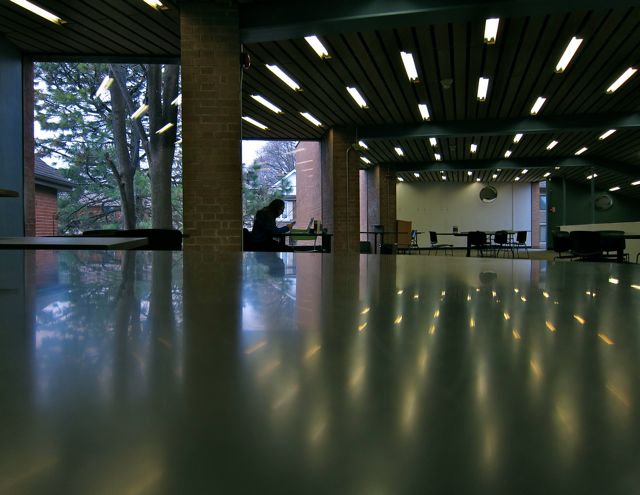
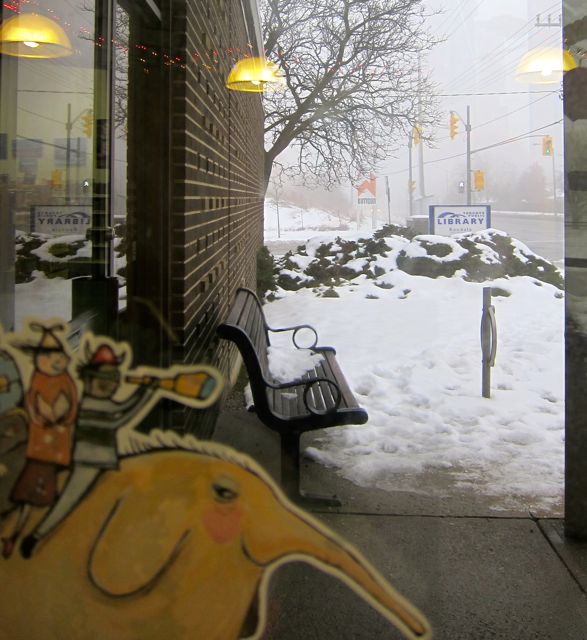
The first time I visited Mimico Centennial Library, it was a rainy winter afternoon in 2009. As I walked up the path to this neighbourhood branch, I noticed that its grounds were more extensive than many libraries located in land-strapped downtown. Long benches rested on a courtyard, hinting at future summer relaxation under the trees.
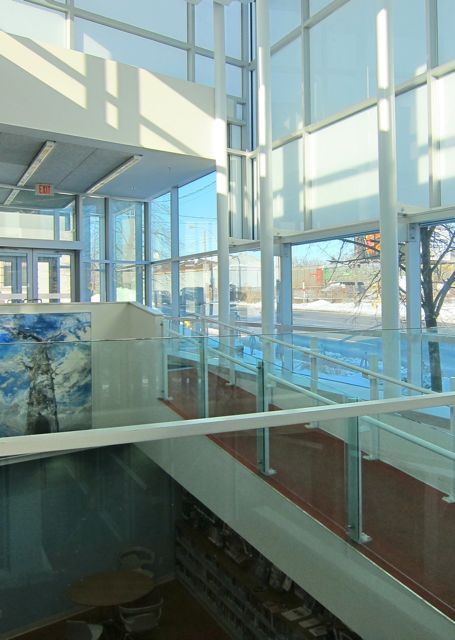
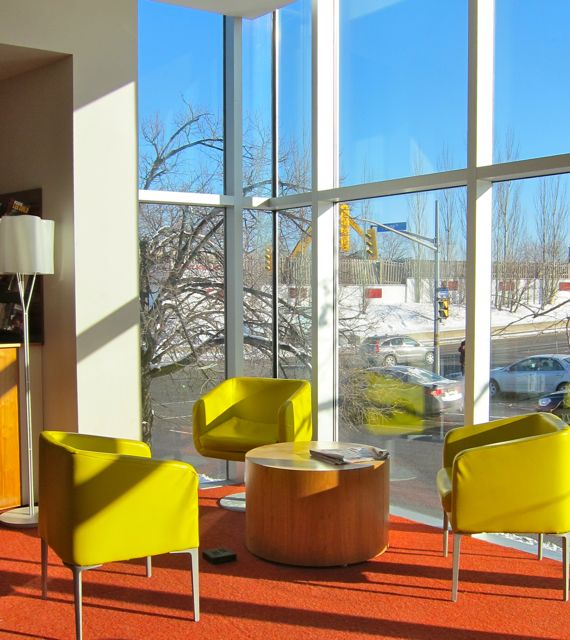
Mimico Centennial’s interior was equally spacious, with floor-to-ceiling front windows and an uncluttered atmosphere. One of the windows featured paper icebergs, snowflakes, and polar bear families floating in a carefree manner. Other windows in the branch came with blue leather window seats, and I was especially delighted with one quiet corner where the seat afforded a view of a fir tree, an ideal spot to compose poems, text messages, and journal entries.
In addition to its daydreaming facilities, I was impressed by the size of Mimico Centennial’s Polish collection, which filled almost two-thirds of one entire wall of shelving. The other third was comprised of materials in Russian, with Spanish and ESL also making a respectable showing. In addition, the Children’s section had a number of books in French.
Shifting my gaze from the shelves to the ceiling, my curiosity was intrigued by an upper level that could be reached by iron staircases on either side. This platform occupied part of the ceiling space of the main floor and served as a study area (similar in structure to the minstrel galleries at Wychwood, High Park, and Beaches branches).
The north stairs beckoned, so I went up to investigate the platform. When I reached the upper floor, I was surprised but not displeased to find mostly empty space. Only a few tables distracted from the vast expanse of carpet, and I saw just one educational display, a literacy tool featuring twenty-six paper frogs stuck to the west wall. Each frog was wearing a letter on its belly, and lists of words which started with that particular letter were written underneath. Six of the alphabet-loving amphibians were still patiently waiting for their words: frogs J, K, Q, V, X, and Z.

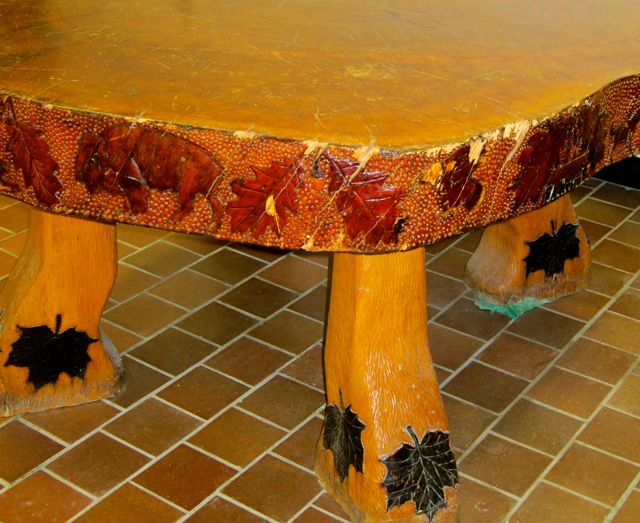
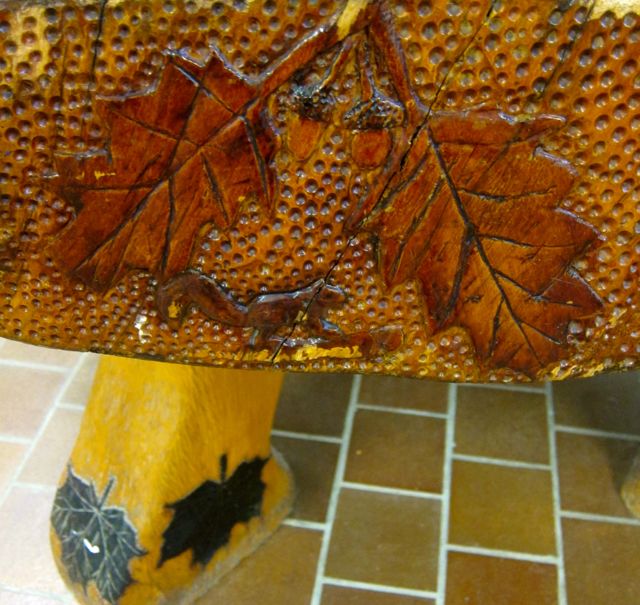
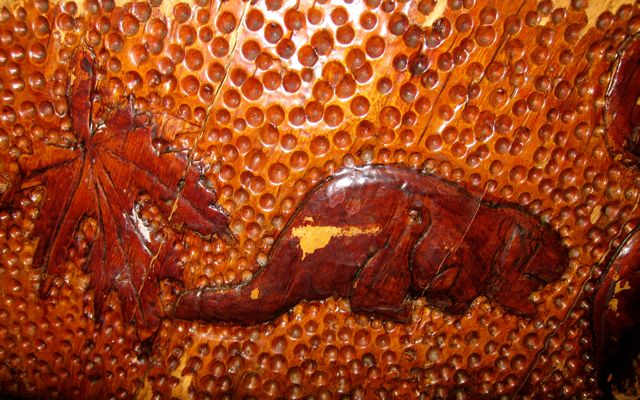
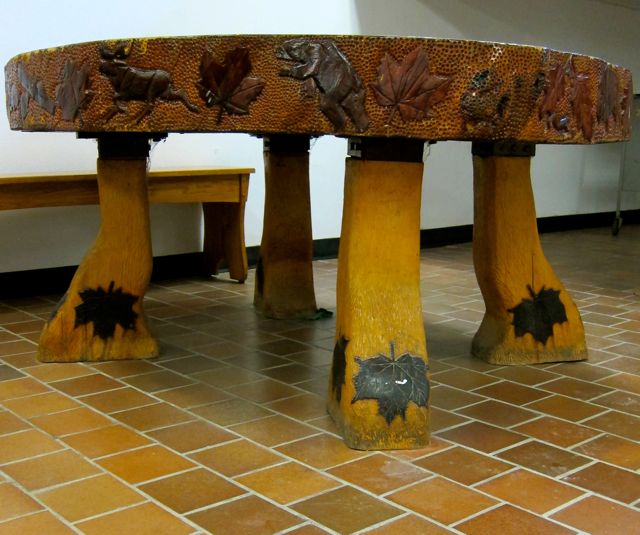
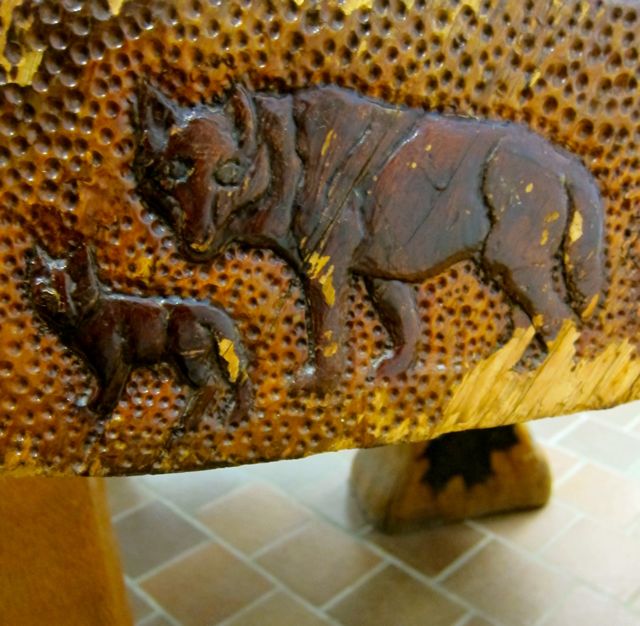
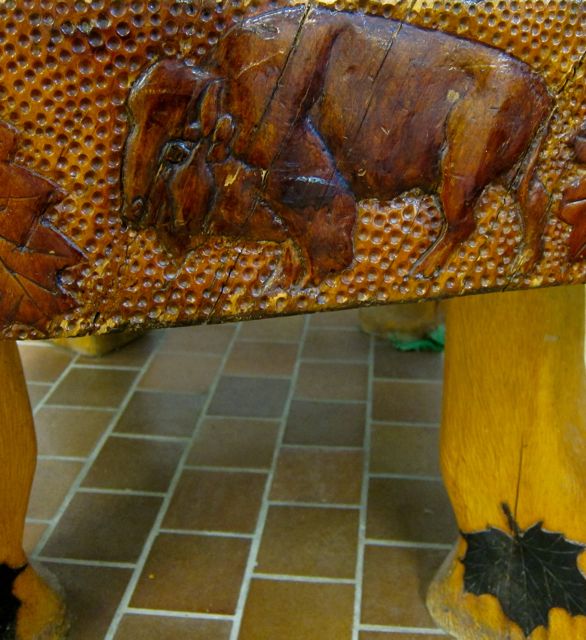
After descending the south staircase to return to the main level, I found a Bollywood DVD and trotted over to the checkout desk, where a personable librarian bade me to enjoy my selection. Then I ran down to the basement level to admire a glossy round table made from a giant tree-trunk. The carvings of wolves, buffalo, beavers, deer, foxes, and maple leaves provided the perfect patriotic symbolism to celebrate an edifice constructed one hundred years after Canadian federation.

When I stepped into Rexdale Library’s lobby on my first visit, I spent several minutes studying a historical display about the library. It included a fascinating newspaper clipping that showed how rural Kipling Heights used to be in 1955.
Though not as empty as the field in the photograph, Rexdale wasn’t crowded on the afternoon of my first visit. Near the west wall, a couple of elderly men reminisced about post-war TTC fares that cost six cents.

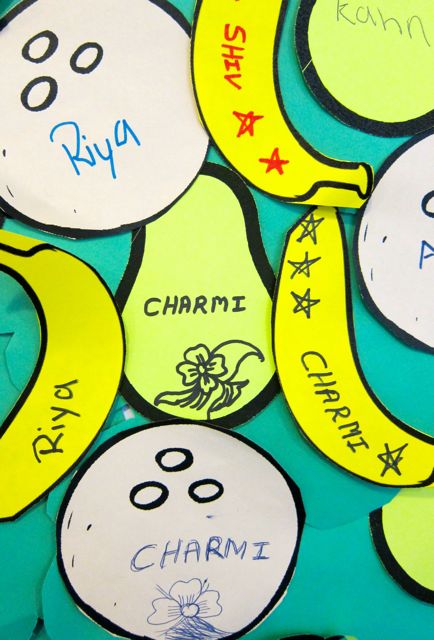
A few shelves away from the gentlemen’s table were books and DVD’s in languages that were rarely heard in Kipling Heights fifty-five years ago: Gujarati, Punjabi, Spanish, and Hindi. Complementing the multilingual materials, a paper tree bearing name-fruit provided more examples of Rexdale’s rich diversity.
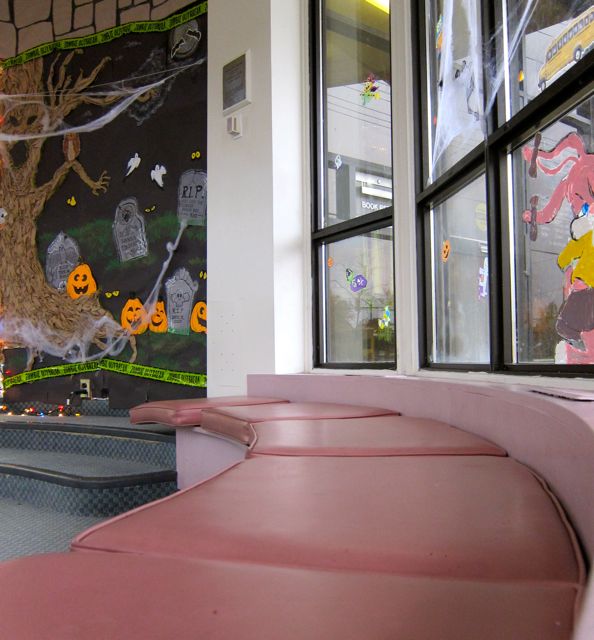
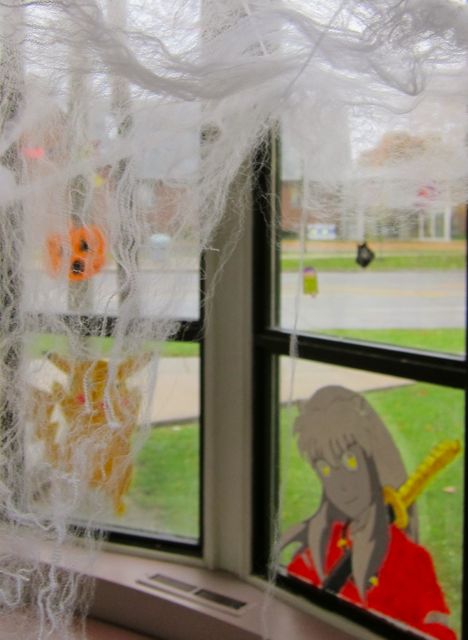
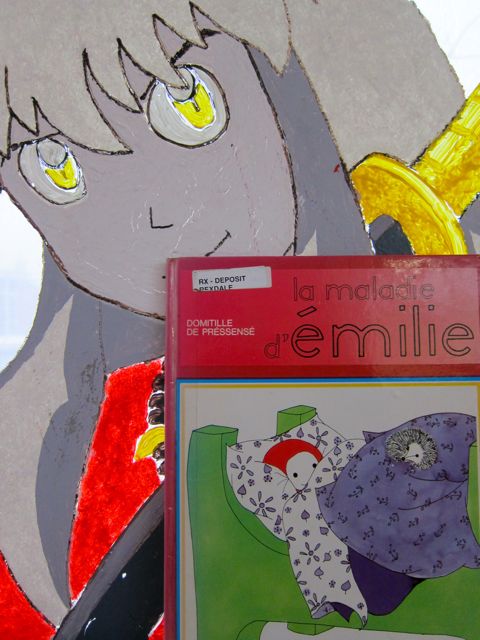
The tree was located to the left of a C-shaped bench under the west bay windows where Lola Bunny, Dora the Explorer, Winnie the Pooh, Pikachu, and an Anime Warrior Girl dwelled.
Opposite the windows, a wooden sliding screen completed the circle started by the window seat. The screen’s flexibility made it possible to enclose the area and define it as separate from the rest of the library. Emphasizing the room’s singularity, a circular depression in the middle suggested a woodland pond.
Two carpeted steps led readers down to the pool, providing a suitable transition from land to water. With late afternoon sunlight shining through the bay windows, this otherwise ordinary branch was transformed into a cartoon gallery.
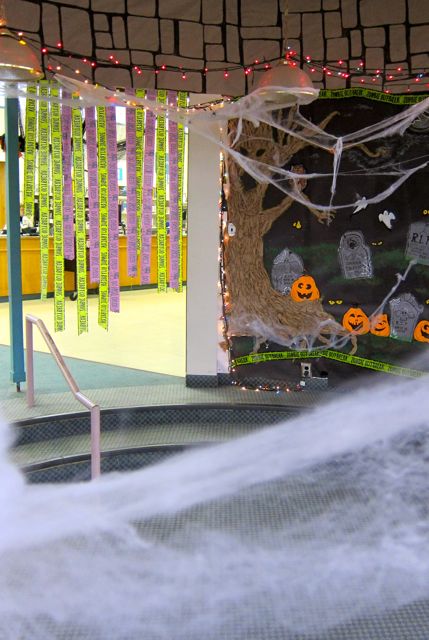
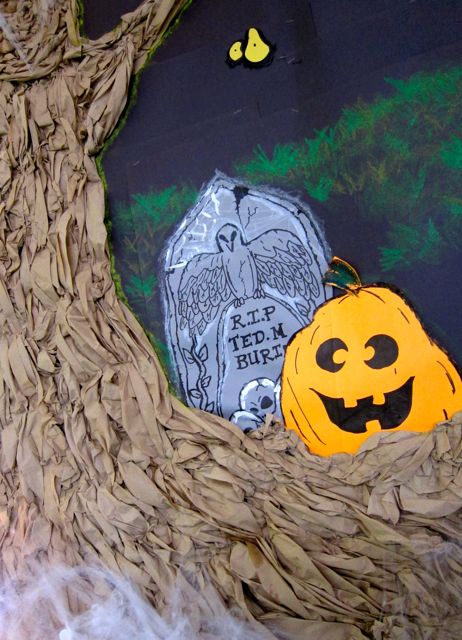
The effect was even more theatrical on a return visit in October 2014, for the paper tree had turned scary for the season and atmospheric cobwebs draped the room.

Rexdale Library, thank you for your history, diversity, cartoon characters, and willingness to celebrate the changing seasons!
The story of Taylor Memorial Library is a love story. In 1962, Fred Taylor donated his 1921 family home to the Scarborough Public Library Board as a memorial to his first wife, Florence Nightengale Taylor. After twenty-two years as a library, the house near Kingston and Warden was demolished and the current building opened in 1985 on the same site.
When I visited Taylor Memorial for the second time in 2011, I realized that I had previously overlooked a black and white photograph of Florence Taylor in a long formal gown. A lovely flowering vine curled around her photo on the white mat between the picture and the frame. To the right of Florence’s tribute were photographs of Fred Taylor and his second wife, Kate.
I was sorry that the original Taylor house no longer remained because I would like to have seen it. The next best thing was a painting of the 1921 home which hung above the east side of the fireplace. The artist, Nikita Marner, presented the viewer with a tall fairy-tale cottage distinguished by a timbered exterior.


Befitting a library whose origins were rooted in an actual house, the current Taylor Memorial building struck me as more home-like than many of the other TPL branches. As I took in the library’s interior, I was impressed by how faithfully it upheld the spirit of the Taylor’s gift: a home to serve as a sanctuary for quiet reading and reflection.
I hope Fred and Kate would have been pleased that I found Taylor Memorial to be the least institutional of all the seventy-four branches I had visited before I encountered it. Each piece of furniture was just right for settling down for a good long read, including the lawn chairs on the covered patio by the garden, the armchairs near the fireplace, and the semi-circular cushioned window seat in front of a bay window.


Three elegant paintings of the Scarborough Bluffs (one of the original cliffs in Yorkshire and the others of the local Ontario version) also made the interior space feel more domestic. They served as reminders of the real lake that beckoned in a sparkly manner just a few miles away.

On the south wall, an arched stained glass window lent a sacred element to the relaxing atmosphere. Echoing the floral embellishments on Florence Taylor’s photo, translucent butterflies and a few birds fluttered attendance on a flowering vine that filled most of the window.


With its high windows, refined paintings, garden views, and comfortable surfaces, Taylor Memorial branch invited peace into the soul. If you are a visionary or just someone who loves to read in a state of restful abandon, I highly recommend a pilgrimage to this harmonious library. Taylor Memorial’s reader-friendly aesthetic embodies the loving spirit of its benefactors, Fred and Kate Taylor.
On a summer evening in 2009, I walked from my house to Liberty Square Shopping Plaza to attend a celebration of the freshly renovated Kennedy/Eglinton branch. Architects had repurposed the seedy bar next door, turning it into a library extension complete with a computer lab, community room, reading lounge and automated checkout area.
More than doubling the space, the expansion and renovation has made Kennedy/Eglinton Library almost unrecognizable compared to its pre-2009 manifestation. What had once been a cramped outpost of learning is now a spacious establishment that brightens Liberty Square.

From the polished tiles in the new entryway to the sparkly wall panels in the Teen’s area, the entire facility embodies hope in new beginnings. The improved Kennedy/Eglinton branch also offers many textured spaces, corners, and rooms that contain a variety of furniture: plush armchairs, a study nook with three-cornered bench, and a window seat in the children’s section.

On the evening of my 2009 visit, patrons of all ages had come out to experience the new library, and they occupied almost every table, computer and study area. As I wandered through the rooms, impressed by their vitality, I appreciated the linguistic diversity reflected in shelves stocked with Chinese, Tamil, and Hindi materials. The community room was surprisingly quiet, but signs of recent social activity lingered, including paper cups heaped in the trash and an empty silver tray smeared with blue and white icing.
However, minor disappointment over a missed cake opportunity could not spoil the grateful mood inspired by this expanded branch in Scarborough Junction. The building’s makeover has not only improved its architectural looks; it has made the area feel safer. Before 2009, I used to feel intimidated to walk over to the library at night and drop off books because bar patrons would be perched on the outside window ledges of the library underneath signs that said, “Do not sit near the drop box.” Post-renovation, a former tavern tarnished by reports of criminal assault has been transformed into a handsome place of learning that serves as a community sanctuary. Long may its light shine!


From its welcoming bronze owl to a quilted mural under a hammerbeam ceiling, Beaches Library is as an exceptionally photogenic building.
The transition from Beaches’ exterior to interior is not abrupt, for not only is there a reading garden outside, but numerous windows also create a close relationship between the indoor patron and Kew Gardens outside.
On my visit to Beaches Library in 2010, the trip felt like an al fresco outing because of all the abundant natural light. For instance, the long cushioned window bench on the west side of the first floor was drenched in sunshine, making it the perfect place to commune with a storybook.

Further coziness could be found in a wooden reading hut that sheltered a substantial blue cushion. On the same 2010 visit, I heard the sweet voice of a mom reading The Ugly Duckling to her child. They were inhabiting the playhouse comfortably, as if they had read there many times before.
Moving from the Children’s Section to the check out area, I paused to admire a paper jungle that had taken root on the doors leading to the meeting room. On a pre-2010 visit, the door had been open, offering a glimpse of a wooden puppet theatre and an old stone hearth within. However, this time, a dangling monkey, a fierce snake, and not-so-fierce butterflies guarded the door.

Even though I had previously visited Beaches branch many times, I nevertheless walked up the stairs to the second level with a sense of anticipation on picture-taking expeditions in 2010 and 2015. I wasn’t disappointed either time, for the high timbered ceiling that identifies Beaches with its sister 1916 Carnegie-funded libraries, High Park and Wychwood, was as gorgeous as ever. In my view, Beaches’ choice of wall paint contrasted very well with the dark wood, taking dignified warmth to another level with an intense shade that fell somewhere between electric nectarine and the ruby red of a Jolly Rancher candy.


Ascending to the minstrel gallery near the north wall and gazing over the grand east wing, I felt an airborne kinship to the great blue heron pictured over the stone hearth on the opposite wall. Everyday concerns seemed less important from this inspiring height.

When I stopped taking photos from the high gallery, I returned to the second floor to study a quilted tapestry. One of the librarians explained that it had been created in 1984 by local community members and library staff to celebrate the sesquicentennial of the founding of Toronto. The textile piece depicted park frolics and beach excursions in a playful variety of colours.
In addition to the quilt’s colours and textures, what impressed me most was the painstaking way that individual panels connected with each other. If one small section had a footpath sewn on it, then the section below it would be sure to continue the path and incorporate it into its own particular scene.

Kneeling in front of the mural, I got in the way of a hapless staff member who was only trying to sort books from a cart. I wanted to move to a place where I’d be less obstructive, but the more I looked at the quilt, the more stitched details I found to fascinate me.


I was especially taken with the puffy trees, squirrels, and whimsical figures enjoying their day at Kew Gardens and the beach. And on a lower panel to the right, I loved the way a woman with an orange buggy was about to stroll directly into the magazine sale on the shelf.

When I finally tore myself away from the quilt, my arms were sore from aiming the camera over my head so many times. My next focal point was the stone hearth on the south wall, which imagination furnished with blazing fire and early twentieth-century patrons vying for fireside reading spot.
Moving from the east to west wing, I noticed some casement windows embedded in the stone overhead, providing a fitting transition from the loftily elegant east side to the more intimate west. My last stop for the day was the reading lounge on the upper west wing, where streaming sunlight and comfortable leather chairs created an ideal atmosphere to relax at one of the loveliest branches in the TPL system.

Through no fault of its own, Woodview Park Library resides in a shabby strip plaza near the intersection of Sheppard Avenue and Weston Road. Even though the branch lacks actual views of woods or parks, sunbaths from the storefront windows compensates for the spartan interior.


The teen nook offers a welcoming bench and some Beatles-inspired artwork, creating an ideal corner to read a magazine or graphic novel in the sun.

A smaller table on the opposite end of the single-room branch signals the start of the children’s section. On the table, a large container of crayons invites creativity into the library. The east wall contains the the brightest decorations at Woodview Park. Adhering to this wall are the same wooden cut-outs in the shape of joyful kids that Black Creek Library has.

Below the cheerful artwork, low-budget yet inventive taped objects offer visual clues to various categories of books, such as toothbrushes for the Human Body, a tiara and wand for Fairy Tales, foam planets for Astronomy, a shuttlecock and assorted erasers for Sports, and a heraldic shield for Medieval Times.


Woodview Park offers plenty of ESL, Italian, Spanish, and Vietnamese resources as well as volumes in the language of Romance. (Two titles I liked were Cattle Baron: Nanny Needed and Hired: Cinderella Chef).

When I left the library on my 2014 visit, I didn’t feel the wistful ennui of a woman being presented with a butterfly she doesn’t want. The sunny bustle of Woodview Park had turned a dreary winter Saturday morning into a cheerful one.


My first visit to Humber Summit (1974) was a flying one because it was less than an hour before closing when I arrived. A small branch placed on top of a gentle hill, Humber Summit’s interior successfully imitated a comfortable living room.
Contributing to the domestic atmosphere was a group of youngsters on a red sofa who were watching Hairspray. While Tracy Turnblad danced her way to personal and civil rights victories, I looked at shelves that offered materials in Spanish, Italian, Punjabi and Urdu. (On my return visit in 2014, I noticed that Spanish and Italian were no longer part of the collection).
Despite the presence of a ten-headed demon king, Humber Summit’s generously-placed windows comforted me with sunlight no matter which direction I turned.


Though I could have basked in front of the main floor’s windows for much longer, I sensed that the librarians were getting antsy to close, so I dashed downstairs for a quick look. The rooms were locked, but I discovered an auditorium, a couple of meeting rooms, a homework club, and a Leading-to-Reading office. I liked how there was a choice of two different staircases to take you back up to the main level; one led to the northwest corner of the library and the other to the outer lobby.

Minutes before closing, I made a hasty exit to avoid delaying the staff. However, there was still time to admire a sparkly display in the lobby and the business names across the street: Om Cash Bank, Bollywood Lollywood DVD’s, Empanadas, and Asafo Market. As I walked back to the car, all was quiet at sunset on the mild slopes of Humber Summit.

To enter Jane/Dundas Library from the parking lot is to encounter the branch as a visual whole — silver, light-filled, and open. Look down from the lobby ramp and you can see groups of teen patrons in their study nook. Look to the right and the entire main level comes into view. Although Jane/Dundas isn’t a huge branch, such is the innovative use of space that it feels bigger than its 11,648 square feet.


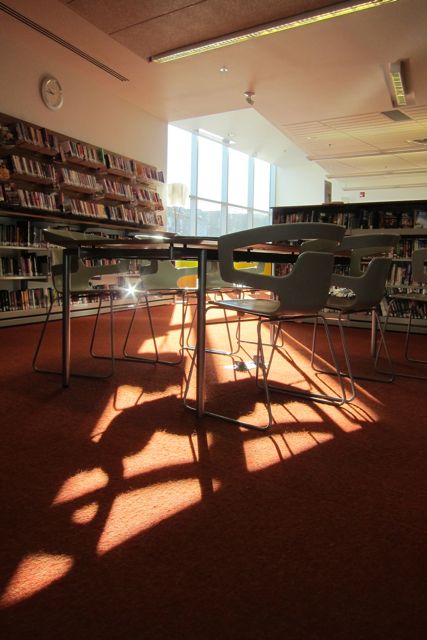
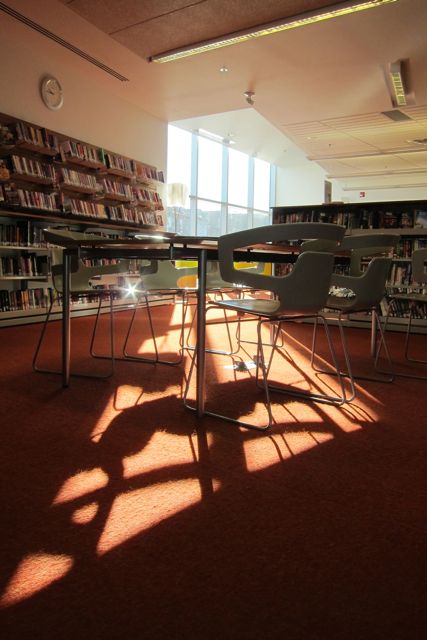
A long carpeted ramp leads to the basement level, inviting a sense of expansiveness. Further openness comes from the generous amount of free space overhead as well as the enormous west-facing window on the main floor, a spot where the sun makes shadow art on the floor of a reading lounge with a 1960’s vibe.

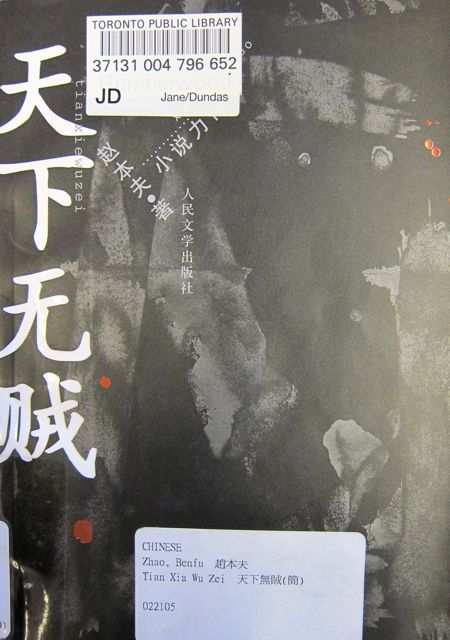
The library’s spatial openness is matched by linguistic breadth, as evidenced by a large ESL section and materials in French, Chinese, Hindi, Polish, Spanish, and Vietnamese. The narrow aisles of the main level also yield substantial fiction and non-fiction collections.

The downstairs level is equally engaging. It has a quiet study room filled with self-improving energy, a beautiful painting of a tree in the teen enclave, and a playful set of shelves in the children’s area. These wooden shelves contain an open square frame that allows young library-users to peer into a storybook zone.


With so many angles, corners, and views, Jane/Dundas provides a dynamic interior upon which to lift your gaze before burrowing back into study. As for me, I’m grateful for a morning immersed in this imaginative environment at the intersection of Jane and Dundas!

Occupying a position on the northwest frontier of the Toronto Public Library map, Humberwood branch lies forty-three kilometres from my home in Scarborough. Like Alderwood Library far to the south, Humberwood shares accommodations with a community centre and a school. These branches serve double-duty as school and public libraries.
Although the grounds of Humberwood Community Centre bordered a cluster of suburban houses, a rural atmosphere prevailed thanks to tall grasses that ringed the building and softened any blunt angles.

Due to my prairie upbringing in Missouri, I have a natural tendency to swoon over wild grasses, the taller the better. I also like my grasses as frondy as possible, for tassels and tufts catch the wind more easily. That’s why exulted when I saw a so many luscious grasses heaped up in front of the Humberwood Library’s entrance. Increasing my delight, a curved footbridge led to the front door, providing a sense of passing through a wild field.

Humberwood’s interior also felt very welcoming and open, especially when I caught sight of an inspired window seat — one long semi-circular swoop of light and wood. Enchanted, I quickly perched on it to soak up the view from the inside. There, I admired some cottony tufts and felt sun-warmed and content.

A few paces from the wonderful bench was a rope hammock hanging from the ceiling. Nestled together in a cuddly heap were two gorillas prepared for study with a book, folder, and positive attitudes. Closer to the ground, resources in Hindi, Gujurati, and Punjabi were located a few bookshelves away from the hammock residents. French materials were also available near the children’s section.
A large paper tree and attendant dinosaurs — all holding prehistoric court among rocks and tissue paper on top of a sturdy bookshelf — announced the presence of the children’s area near the south wall. Sea and jungle creatures flanked the dinosaurs on their own shelf-tops.

On my first visit in 2009, what tickled me about the southwest corner of the library was the zany collection of Barbie dolls and action figures that dangled from the ceiling on fishing lines. One macho doll commandeered a motorcycle while a Barbie in a safari suit clutched his waist from behind. A few ceiling tiles over, a plastic man in a gas mask was parachuting towards some picture books. Nearby, a female and two male Barbies formed an aerial karate trio while more decorative (but less dynamic) dolls modeled nightclub outfits and a swimsuit.
The central ceiling-piece of 2009 was a large black helicopter complete with a rugged pilot, a female passenger in impractical gold boots, and a Rocky-impersonator hanging from one of the runners. Clinging to the wall was a rock-climbing Ken doll, his hands and feet scotch-taped to the indoor cliff. Although I worried about the stereotypical gender roles this display might be reinforcing, I couldn’t help but smile at the playful gaggle of dangling Barbies.

Below the Barbies, a collection of stuffed animals had been placed in a friendly pile where two shelves formed a corner on the west wall. A large stuffed Teddy-bear held a blue Wuvluvs alien on his lap. When I returned to Humberwood in 2014, the Wuvluv had migrated to a shelf that contained an Eiffel Tower replica and five paper boxcars.

More boxcars rode wildly overhead a few steps to the right, replacing the Barbies of five years ago.


Descending to the middle air, a fairy habitat graced the shelf near the children’s computer bay. Standing at attention, a wooden clown guarded the emergency exit, waiting for a photogenic face to fill the empty circle.


Although the clown didn’t persuade me to stop for a photograph, I still had a wonderful time in this spacious one-room library on the edge of Toronto’s city limits. A literary surprise amid tall grasses, Humberwood Library is now on my list of favourite TPL branches.


The penultimate Toronto Public Library I visited on my quest was one of its smallest: Swansea Memorial. This compact branch occupied one room on the upper floor of Swansea’s City Hall, where it has resided for fifty-six years. (Previously, it was located in Swansea Public School from 1919 to 1959).

With only 1,127 square feet of floor space, what Swansea Memorial lacked in size was compensated by epic historical flavour. Even its study table had a history; carpenter S. Haslam built it in 1926.

I liked the pioneer vibe of this venerable library, for it evoked the one-room schoolhouses of Little House on the Prairie and Anne of Green Gables. In fact, Anne’s famous Canadian author, L. M. Montgomery lived in the village of Swansea from 1935 until her death in 1942, as Mary Henley Rubio details in Lucy Maud Montgomery: The Gift of Wings (p. 446).
As evidence of further connection to Swansea Memorial, the library had a copy of a 1939 letter that Montgomery signed. The letter praised one Mrs. R. C. Smith, a woman who served as chairperson of the local library board for twenty years.
From a leaflet about Swansea Memorial Library’s history, I learned that credit for its creation belongs to the Women’s Patriotic League of Swansea, who wanted to honour the 152 freshly-returned local veterans of the First World War as well as “our twenty men who sleep in Flanders Field” (see letter above).

However, soldiers’ tombstones and Haslam’s no-nonsense table didn’t completely define Swansea Memorial. The trippy whimsy of a tie-dyed kite, a plush turtle and a mural cat with its paws on an outlet softened the solemn military associations of the library’s name.


My last act of homage at Swansea Memorial was to study the folksy mural on the outer wall of the library. I loved the lively colours and the way the art piece transformed the interior of an official municipal building into a friendly community space. I also appreciated how the mural held the tension between memorial and celebration, making it an ideal spot to reflect on a pilgrimage to all of Toronto Public Library‘s branches.
Thank you, Swansea Memorial, for remembering lives lost in war and appreciating flowers, ladybugs, cats, swans, turtles and squirrels.

After crossing a footbridge over multiple railroad tracks, I found TPL’s newest branch around the corner from a new Tim Hortons and shiny condominiums — all on a brand new street.

Excited to photograph my 99th branch, I began in the first-floor reading lounge, which offered sunlit construction scenes and useful red benches that spanned the length of the west wall. When the benches reached the children’s section, a bookshelf appeared underneath the perching surface, showing consideration for the height and reach of TPL’s youngest patrons.
On the day of my visit, forty-one babies arrived to take part in the morning’s Baby Time program. This massive turn-out forced the giant ABC letters in the children’s area into temporary exile in the lobby. During the 30-minute program, I enjoyed how the sound of the energetic rhymes carried throughout the open space of the two levels, enriching the learning atmosphere by making it home-like, cheery, and inclusive.

The spaciousness of the branch supported one of the defined goals of Fort York Library, which was to welcome nearby condo-dwellers who might need extra work space outside of home. I learned this fact from the Children’s and Youth Services librarian for Fort York (a friendly young woman with crayon marks on her business card who fist-bumped customers that she knew by name). She also told me that many young families with children inhabit the local condos, hence the impressive showing at the program.
As I explored Fort York, I came to admire how TPL’s welcoming intentions manifested themselves in details such as Baby Time programs, ottomans with outlets, and study pods that resembled stylish covered bridges.


I also appreciated Fort York’s unique position as an observation post in the very heart of intense construction activity. From almost every vantage point in the library, evidence of a city on the edge of change met the eye.


Even the soaring angles of the ceiling and girder-inspired plays of light from the windows gave an impression of dynamic energy.

Although rampant construction near the shore of Lake Ontario rouses mixed reactions, nobody can accuse Toronto of simply standing still. Today’s dirt promises to be tomorrow’s Mouth of the Creek Park.

Whether you find the changes irritating or simply invigorating, Fort York Library provides both a frame and an example to showcase an evolving city in all its grubby glory.


What distinguishes Bridlewood Mall from less mortally-aware malls is a small cemetery in its parking lot. In the picture above, the word “low” in the supermarket’s sign is positioned such that the tombstone is a pointing to it in a somber yet market-savvy manner.

Before I investigated the library’s new location in 2011, I haunted the ghostly site of its previous home. Looking through the window, I remembered my 2009 visit to Bridlewood Library and how I’d described a rocket made out of construction paper and aluminum foil.
The sadness of the empty room was tempered by its resemblance to a potential set for an ’80’s dance movie like Footloose or Flashdance in which a solitary dancer turns a warehouse or some other unlikely spot into a personal stage. (Then a love interest will unexpectedly witness the performance, startling the solitary dancer).
Shaking off the dance reverie, I took the escalator down to the lower floor of Bridlewood Mall. As I was gliding down, I eagerly scanned left and right for the newly-located branch. I finally spotted it between Shoe Club and Shoppers Drug Mart, and I spent a few minutes taking it in.

The raw energy plywood and bold zigzags first caught my attention. Even though Bridlewood was alive with people, it still managed to look spacious, especially in contrast to the crowded shops surrounding it. I liked the high ceilings and the thick vertical bands of colour that reminded me of a TV screen on a station break.

The intensity of human activity was remarkable at this branch; dynamic patrons were coming and going, reading and browsing, studying and surfing the web. Every single study carrel had a scholar, blue stools supported grandmothers in the children’s area, and at one table two young siblings shared a chair without a squabble. I even saw one determined reader sitting on the floor between shelves. She was happily absorbed in an atlas, head lowered for fuller map immersion.


In the northeast corner of the room, an animated reading circle for children was in progress. One of the teachers explained to a parent, “We’re playing Scrabble. It’s a good game to increase vocabulary and spelling skills.” In an enthusiastic voice, she encouraged the kids to pick out letters (like “T” for tiger) and read the words on the game board.
On the west side of the library, funky tables and mailing tubes created a fanciful reading space in the children’s area. Overhead, the lanterns embodied a vision of jellyfish clouds.


At first I was unsure if I liked the packing tubes because they reminded me of upright cigarettes, but I gradually came to terms with them as interesting space dividers.


Rectangular windows in the plywood divider between the reading lounge and the children’s collection offered additional fresh perspectives as did artistic trees etched in milky glass facing a wide mall-corridor.

As I took a final admiring glance at Bridlewood, it was a joy to see so many families spending their Saturday at the library. Youngsters were hoisting as many books as they could carry and hauling them to the check-out. Adults toted canvas shopping bags brimming with TOEFL guides and magazines.

All in all, Bridlewood branch had a beautifully exuberant atmosphere despite the presence of a graveyard in the parking lot. Not even Victorian tombstones could inhibit this renovated library’s vivacious spirit!
A visit to Haliburton Wolf Sanctuary was one of the highlights of a recent family vacation to central Ontario. We were fortunate to see so many wolves from the observatory last Wednesday because the pack could have decided to hang out elsewhere within their 15-acre enclosure.


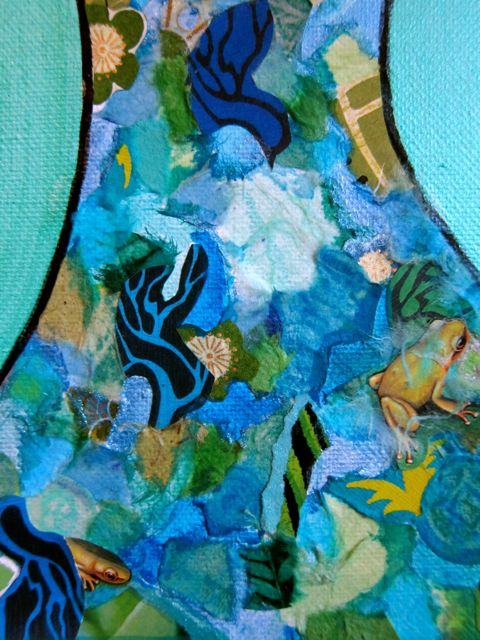
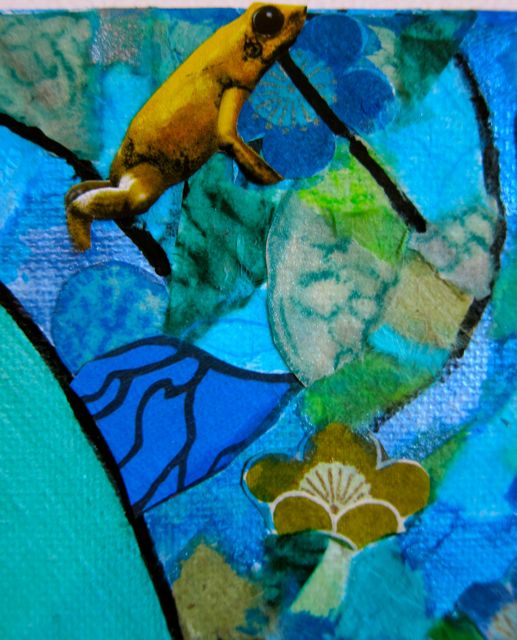
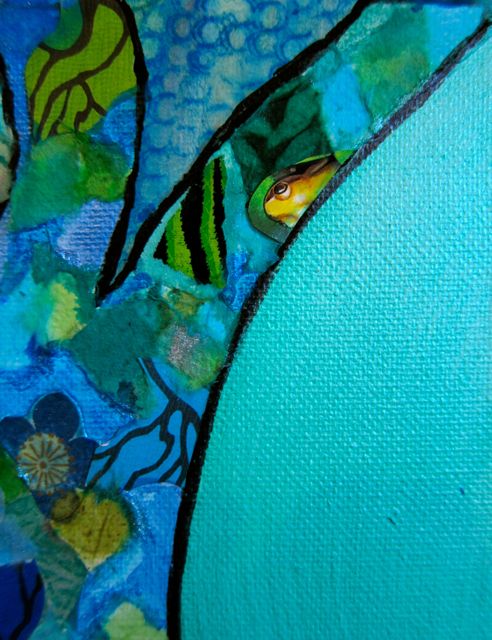
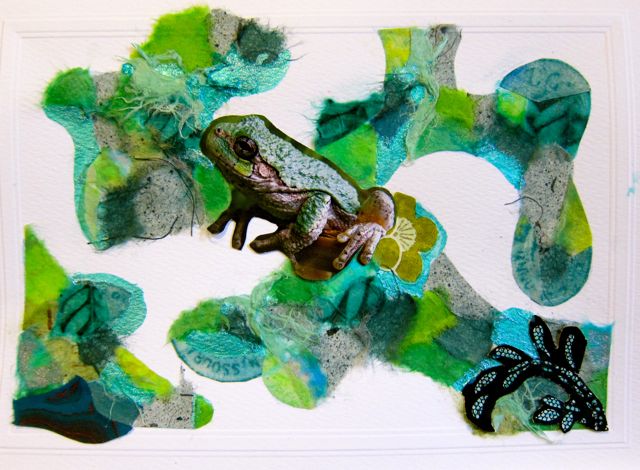
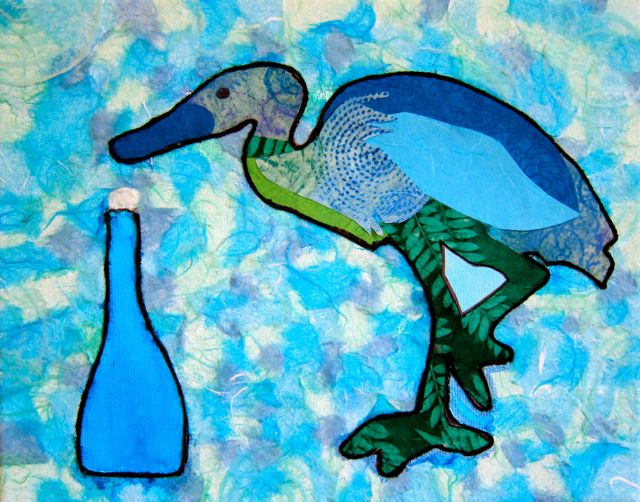
From random piles of paper, stickers, and images arose eleven collages that showcase the creativity, humour, and playful spirit of their creators. Thank you, ELL students, for your willingness to try a new art form!


In a recent workshop, fourteen students in an intensive academic English program created art from images that inspired them. I love the range of interests represented in the collages below, which include art, fashion, dance, religion, family, flowers, wild animals, waterfalls, sports, and space. Inspiring work, EAP 2 Study Skills!


Supporting the theme of environmental awareness, I recently facilitated two collage workshops for international students at a local college. Using recycled paper and images to great effect, the participants created a total of twenty-seven strikingly individual collages that delighted their teachers, their classmates, and me.
Please enjoy this on-line tribute to recycling and creativity!


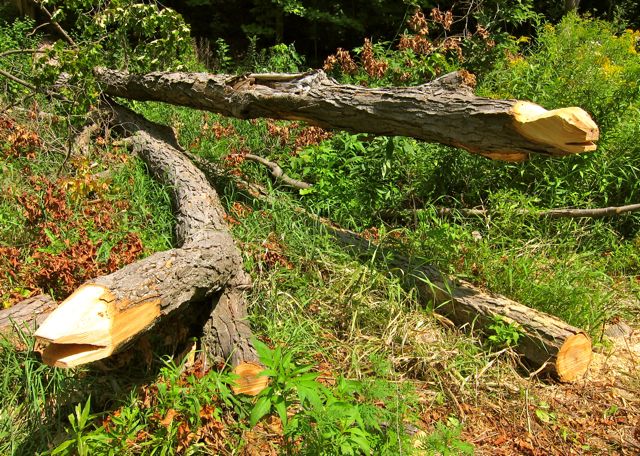
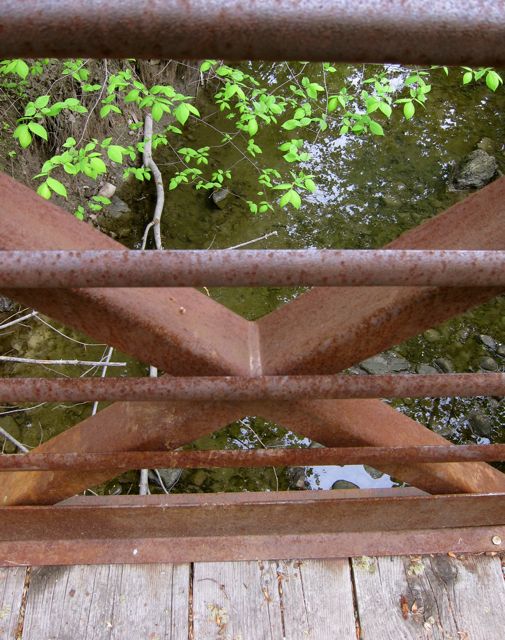
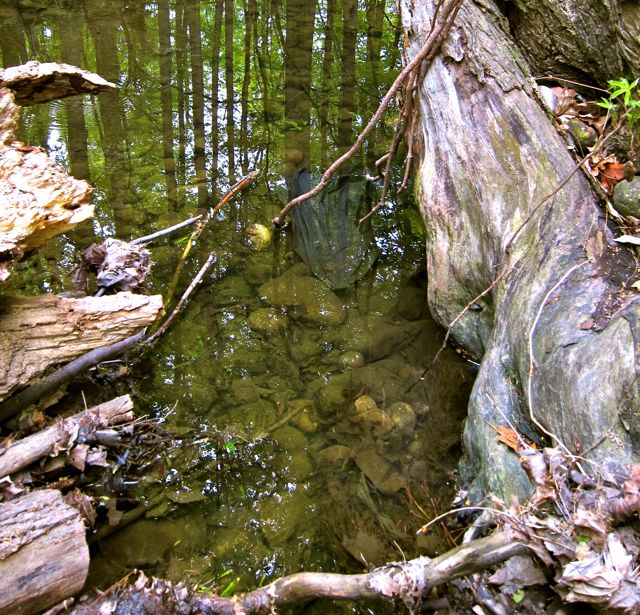
Beside Deer Lick Creek, I saw a hare bound across an iron footbridge and a giant tree that had snapped in two when it fell in the water. Pausing my walk, I stood on the bank to study the tree.
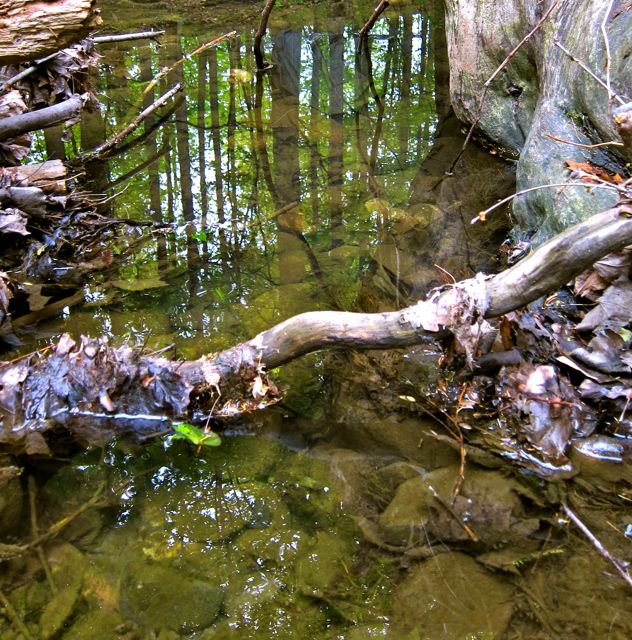
The distance between severed stump and trunk was not great, but the liquid space between the two jagged ends took my breath away with its beauty. How could the fallen, the broken be so beautiful?
I loved how the brook filled the void of disconnection and death, blessing an abyss with a measure of peace. The slow movement of water, the round stones on the creek bed, and the reflections that animated the skin of the creek, they all witnessed loss and grief with grace. They comforted me.
That tree died, but beauty didn’t die. It just changed. A whole tree, intact, thriving, with glossy leaves is beautiful. But a broken tree with only half of its body still rooted in a muddy bank is gorgeous too.
The shocking break is an opening for time, change, and water to move — not to take the pain away but to lovingly acknowledge its impact. The broken edges can breathe into that forgiving emptiness, exposing their ache to the kindness of night.


Located inside East York Community Recreation Centre, Todmorden Room is the smallest Toronto Public Library branch. With a maximum capacity of 33 people, the humble size of this facility gave it extra charm, a welcome throw-back to a slower, more relaxed era before automated check-out stations and big city anonymity.
The main desk of Todmorden Room was directly in front of the entrance, and my husband Stewart was struck by how the librarian greeted each incoming patron by name. Even though there were only eight people in the library (including two staff members), we kept tripping over each other as we moved up and down the two short aisles.


The only multilingual resource I noticed at Todmorden Room was a Spanish learning kit with a CD, and the ESL collection had only fourteen books (hardly the fault of library with so little space to spare).
As at Woodside Square, Eglinton Square, and Bridlewood, the romance genre was well-represented, and it included a couple of titles that caught my attention: Kidnapped by the Cowboy and Outback Boss, City Bride. (While visiting the outback, I hope the urban spouse offers Marxist-feminist workshops on marital gender roles).
As I exited the room, I noticed a beige locker beside the check-out desk, possibly a hand-me-down from the gym down the hall. I liked how the library was well-integrated into the community centre, which also offered swimming and martial arts classes. In fact, I learned from the librarian that families often coordinate their trips to the branch around activities at the centre.
Way to go, plucky Todmorden Room! You bring the convenience, the family welcome, and flower-inspired children’s art!


I first wrote about Brookbanks Library in 2007, but it was only one line about this “quiet branch near a karate school in North York.” Two years later, I called in for the second time so I could describe the branch more fully. And then I visited for the third and fourth times in 2012 and 2015 to take some photographs.

Unobtrusively tucked behind a shopping plaza, Brookbanks Library contained an auditorium on the lower level, a main level, and a raised platform near the back of the main level that occupied about a quarter of the interior space. Connecting the main floor with the upper platform was a short flight of steps and a ramp in the shape of a backwards letter “L”.
Just to the right of the entrance on the east side of the library, materials in Farsi, French, Chinese, Hindi, Spanish, and Romanian caught my eye. In response to a shift in local demographics, a couple of notices advised that the Russian collection had been moved to Fairview Library, as had the Tamil collection (which could also be accessed at Maryvale branch).


As I rounded the northeast corner of the main floor, I came upon agreeable window seats along the north wall. They were plush, gently purple, and low to the ground. On my 2012 visit, I noticed that the purple covering had morphed into dark grey with a pattern of abstract loonies and toonies.

A matching window bench, though upholstered in green in 2012 and aqua in 2015, was in the teen section on the raised upper level. Young patrons who were reading in a sprawl on the floor and lounging in their socks on green cushions gave the library a homey atmosphere. I liked how nobody was shooing them in the direction of more conventional surfaces like tables and chairs.

After relating to the furnishings on the upper level, I took the ramp back down to the main floor, which gave me the opportunity to check out an elaborate mural by G. Eversole (1997) that stretched across a third of the north wall and most of the west wall. The centrepiece of the work was a large tree trunk from which grew copious foliage spreading in two directions.

The more I looked into the leaves, the more entities I discovered: a green monster claw grabbing a purple book, the yellow hat of Curious George’s guardian, mangoes, a sign that warned of napping Grues, a second descending monster with pink toe-talons, and a Famous Tails collection that included thin tails, fat tails, and striped tails in assorted colours.


The last set of window seats of the day were flush against the south wall in the children’s section. A huge white bear, taller than many of the aspiring readers in his jurisdiction, hosted a number of other stuffed animals on his person. Three bunnies — Bugs Bunny, a generic rabbit in calico, and one in a camouflage jumpsuit — rested on the bear’s lap while a turtle and small bear occupied his right leg. A large Curious George doll sat to the big bear’s left and rested a friendly monkey paw on his shoulder. A copy of Knut the Baby Polar Bear was propped on the bench just below George’s paw.
Between 2009 and 2012, something chaotic happened to the stuffed animal collective. In 2009, the group was composed and dignified, but the disorderly scene in the following photo suggests a surprising behavioural change.

Did these animals attend a wild rumpus the previous night? Even the sweet small duck looked as if it was having a rough morning-after experience.

Taking a final glance at Brookbanks Library, I noticed a fuzzy piranha in green and blue near my left foot. Although its many teeth were made of felt and my shoes were close-toed, I decided it was time to catch an express bus on York Mills Road without delay.

Thank you, Brookbanks Library, for your gorgeous trees, colourful mural, and plentiful window-seats!